Credit Card Casinos in the UK: What Actually Works in 2026
 Available in GB

Short version, before anything else: there are none. Not a single casino holding a licence from the UK Gambling Commission has been permitted to accept a credit card deposit since 14 April 2020. Any site showing you a Visa or Mastercard credit option and a British flag in 2026 is operating outside UK regulation, which is a very different proposition from being a bargain.
That leaves the question worth actually answering. If the card in your wallet is off the table, what funds a casino balance instead, which licensed sites take those methods, and how fast does the money come back out? The rest of this page is that map, along with the three routes people try when they want to squeeze a credit card through the side door, and why two of them are already sealed shut.
Table of Contents
- Can You Use a Credit Card at UK Online Casinos? (The 2020 Ban Explained)
- The Best Alternatives to Credit Cards at UK Casinos
- Which UK-Licensed Casinos Accept These Payment Methods
- Credit Card Workarounds That Don’t Work, and One That Merely Ruins You
- What About the Sites That Still Take Credit Cards?
- Can You Play Slots With a Credit Card in the UK?
- Which Payment Method Should You Actually Choose?
- What’s Changing in 2026: New UK Gambling Rules
- Foreign Cards, Payouts and the Edge Cases
- Why the Credit Card Ban Works in Players’ Favour
Can You Use a Credit Card at UK Online Casinos? (The 2020 Ban Explained)
No. Credit cards are prohibited for gambling across Great Britain under licence condition 6.1.2 of the Gambling Commission’s LCCP, in force since 14 April 2020. The ban covers online casinos, bingo, sports betting, high street bookmakers and track betting. It applies to the operator, not to you, so there is no penalty for trying.
The rule was announced on 14 January 2020, giving operators three months to strip the option out of their cashiers. The Commission’s reasoning was blunt and rested on its own consultation evidence: among people gambling online with credit cards, roughly 22% met the criteria for problem gambling, against about 8% of online gamblers generally. Behind that gap sat case files of players carrying five-figure gambling debts, including one who lost £54,000 in a single night across nine separate cards. Regulators rarely move quickly, but a number like that concentrates the mind.
What the ban does is add friction. That was the stated aim, and the Commission was careful never to claim it would stop determined gambling on borrowed money. It simply removed the most convenient pipe between a credit line and a roulette wheel.
Eighteen months in, the Commission published an interim evaluation on 2 November 2021 and found the reaction from players largely positive, with none of the unintended consequences critics had forecast. No measurable migration to other forms of borrowed money. No spike in illegal lending. No rush to credit card cash machines. Data from major high street banks showed gambling transactions on credit cards had fallen to what the Commission described as a very low level, with the residue attributed to purchases that sit outside the ban anyway. Larger e-money firms had independently blocked credit-funded gambling top-ups. Six years later, no reversal is on the table.
Why Credit Cards Are Banned for Gambling in the UK
The principle is that gambling should be funded from money you already have. A debit card empties an account that either holds the funds or does not. A credit card creates the stake out of a credit limit, and the bill arrives later, which is precisely the mechanism that turns a bad evening into a debt with interest running on it.
Two features of credit cards made them worse than an ordinary loan for this purpose. Speed, first: a deposit clears in seconds, with no underwriting, no affordability question, and no pause in which to reconsider. Then the cost structure. Gambling deposits were frequently coded as cash-equivalent transactions, meaning interest started accruing immediately at the cash rate rather than after the usual interest-free window. Losing players were therefore borrowing at the most expensive tier their card offered, at the exact moment their judgement was least reliable.

What LCCP 6.1.2 Actually Says
The operative wording is two sentences, and the second is the one operators had to think about:
Licensees must not accept payment for gambling by credit card. This includes payments to the licensee made by credit card through a money service business. — Gambling Commission, LCCP licence condition 6.1.2, Use of credit cards
That second sentence closes the indirect route. A deposit routed through an intermediary still counts as payment by credit card, which is why loading an e-wallet from a credit card and depositing from the e-wallet does not launder the transaction into compliance.
The ban reaches every remote betting, casino, bingo and pool betting licence, the non-remote equivalents including adult gaming centres and family entertainment centres, and lotteries that take payment online or by telephone. One carve-out survives: non-remote lottery licences. Buy a scratchcard or a lottery ticket over a shop counter, or by post, and a credit card is still legal. The Commission’s own justification was practical rather than principled, holding that it would be unreasonable to expect a supermarket till to isolate a £2 lottery ticket from the rest of a weekly shop. That exemption covers lottery products bought in person. It has never covered casino play, and a site invoking it at you is being creative with the truth.
How the Ban Is Enforced, on Both Sides of the Transaction
Enforcement runs on two independent layers, and almost nobody explains the second one. The operator side is the licence condition: a UKGC licensee that accepts a credit card deposit is in breach, with fines and licence review as the consequence. That is why the option is simply absent from the cashier rather than declined at the end of a payment flow.
The issuer side is separate and predates any casino’s decision. Card transactions carry a merchant category code identifying what kind of business took the payment, assigned by Visa and Mastercard or self-declared by the merchant. Banks including Nationwide and HSBC decline credit card transactions bearing gambling codes outright, and most banking apps now expose a manual gambling block as well. The two layers are belt and braces. Even if an operator’s compliance failed, the card would very likely be refused before the deposit landed.
Neither layer is perfect, and the imperfection is instructive rather than a loophole worth chasing. Blocking depends entirely on the code attached to the merchant, so a transaction that is genuinely gambling-related but coded as ordinary retail can pass. A lottery ticket bought with the groceries goes through on a supermarket’s code. In-game purchases and some prepaid products coded as digital goods can slip past for the same reason. None of that opens a path to a casino deposit, because licensed casinos are coded correctly as gambling merchants and are barred from accepting the payment in any case.
Can you use a credit card at an online casino in the UK?
No. Every casino licensed by the UK Gambling Commission is barred from accepting credit card payments under licence condition 6.1.2, and has been since 14 April 2020. The option does not appear in the cashier. Debit cards, mobile wallets, e-wallets and open banking transfers all remain available.
Why are credit cards banned for gambling in the UK?
The Commission acted on evidence that credit card gamblers showed problem gambling rates around 22%, against roughly 8% of online gamblers generally, alongside cases of players accumulating five-figure debts. The stated aim was to add friction to gambling with borrowed money rather than to stop gambling itself.
When were credit cards banned for gambling in the UK?
The prohibition was announced on 14 January 2020 and took effect on 14 April 2020, giving operators a three-month window to remove the payment option. An interim evaluation published on 2 November 2021 found no harmful side effects, and the rule has stood unchanged since.
What happens if I try to use a credit card at a UK casino?
Nothing happens to you. The credit card option is absent from the cashier at licensed sites, so there is usually nothing to attempt. If you reach a payment screen anyway, your bank will most likely decline the transaction against the gambling merchant code. No penalty falls on the player.
The Best Alternatives to Credit Cards at UK Casinos
Eight methods carry essentially all licensed-market deposit traffic now. They differ less in how they put money in than in how quickly it comes back out, whether they qualify for a welcome offer, and how hard a ceiling they place on your spending. That last point matters more than the marketing suggests: a credit card’s defining feature was spending money you did not have, and two of these methods deliberately make that impossible.

Debit Visa and Mastercard: The Direct Swap
The closest thing to a like-for-like replacement, and for most players the end of the search. Same networks, same cashier form, same card number, expiry and CVV. The only change is where the money comes from, and that change is the entire point of the regulation: a debit card draws on your own balance. Accepted at more than 200 UK-licensed casinos, which makes it the only method you can assume is present without checking.
Payout speed splits along network lines, and the split is wider than most players expect. Visa Direct pushes withdrawals to a debit card in anything from minutes to about three working days depending on the operator’s processing. Mastercard’s instant payout support is still catching up, so three to five working days is the realistic expectation there. If speed is the priority and you have both cards in the drawer, use the Visa one. The other reason to keep a debit card on the account is bonus eligibility: welcome offers are frequently restricted to debit card deposits and explicitly exclude e-wallets, Betway’s 150 free spins being one of several examples. Deposit with Skrill and you can find yourself outside an offer you assumed you had qualified for.
Apple Pay: Fastest Mobile Checkout
A layer over a debit card rather than a payment method in its own right, which is worth understanding because it determines what Apple Pay can and cannot do. Your card sits in the Wallet app, the casino receives a one-time token rather than your card number, and Face ID or Touch ID authorises the deposit. Two seconds, no typing. For anyone depositing from a phone it is the least irritating option available, and support across UK licensed sites is noticeably broader than Google Pay’s.
Withdrawals land in zero to two working days, since the money returns to the underlying debit card. Midnite takes Apple Pay from a £5 minimum with instant payouts, Sky Vegas matches the £5 entry, All British Casino and Betano both start at £10, and The Vic includes it in a six-method cashier. The catch is structural rather than a defect: because it is a debit card underneath, your bank’s limits and any gambling block you have set still apply, and the deposit is not bonus-eligible anywhere the offer specifies debit card only. You also need an Apple device, which sounds obvious until you are on a laptop that is not a Mac.
Google Pay: The Android Option
Functionally the same architecture for Android users. A debit card tokenised inside Google’s wallet, one-tap authorisation, no card details exposed to the operator, and withdrawal times matching Apple Pay’s zero to two working days because the money is going back to the same card.
Acceptance is the weak point. UK casino support for Google Pay is materially thinner than for Apple Pay as of 2026, and the reason is unglamorous: operators integrated Apple Pay first when iOS users dominated mobile casino traffic, and many have not prioritised the second integration. Betano is the useful example on this list precisely because it takes both from a £10 minimum, so an Android household does not need a workaround. If Google Pay is your default everywhere else, check the cashier before registering rather than after, because discovering the gap at the deposit screen means falling back to a debit card anyway.

PayPal: Keep Gambling Spend Separate
The most recognised e-wallet in Britain, and the one players choose when they want gambling money quarantined from the account that pays the mortgage. Funds sit in the PayPal balance, top-ups come from a linked bank account or debit card, and the casino never sees your banking details. Payouts are among the quickest available at zero to one working day, which is the main practical argument for using it over a debit card.
PayPal polices its own boundaries here, and does so more strictly than the regulation requires. PayPal Credit cannot fund a gambling deposit, and neither can a balance topped up from a credit card, which closes the indirect route independently of whatever the casino checks. Availability is good but not universal: Duelz from £20, Dream Vegas, All British Casino from £10, Jackpot City, Betway from £20 and The Vic all take it, while some sites omit it entirely. Note that PayPal minimums often sit above card minimums at the same operator, £10 against £5 at William Hill and bet365 being typical, and that debit-only welcome offers exclude it.
Paysafecard: Prepaid Hard Cap
A voucher, not an account. You buy it with cash or a debit card in a newsagent, supermarket or petrol station, or online, in fixed denominations of £10, £25, £50 or £100, and you receive a 16-digit PIN. Enter the PIN at the cashier and the balance moves. No bank details, no card number, no registration trail connecting the deposit to your finances.
That structure produces the strictest spending control of any method here, and it is the reason to choose it. You cannot deposit money you have not already physically bought a voucher for, which means chasing losses requires leaving the house. As a friction mechanism it is considerably more effective than any slider in an account settings menu. The trade-off is one-directional flow: Paysafecard generally cannot receive withdrawals, so you will need a debit card or bank account on file for payouts, and some sites route returns to a Paysafe online account instead. Duelz, Dream Vegas, All British Casino and The Vic all accept it, typically with a £10 minimum where cards start at £5. It is also excluded from debit-only bonuses, which means the tightest spending discipline comes at the cost of the welcome offer.
Pay by Mobile: Charge It to Your Phone Bill
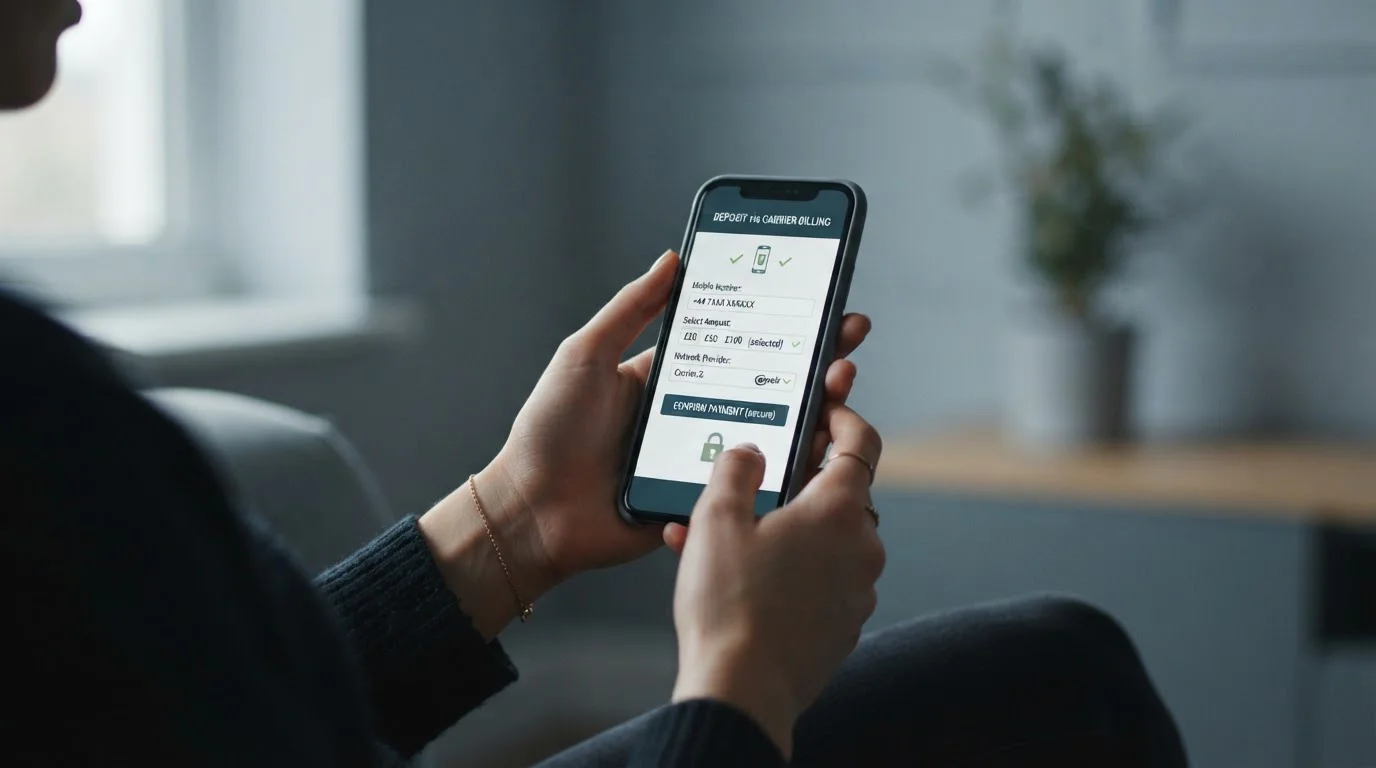
The closest behavioural echo of a credit card, and the one method here that genuinely defers payment. You enter your mobile number at the cashier, confirm by SMS, and the deposit appears on your next phone bill or comes off your pay-as-you-go credit. No bank details, no card, no account setup.
The caps are what keep this inside the rules. Carrier billing is regulated by the Phone-paid Services Authority, with roughly £40 per day and £240 per month as the standard ceilings, and £30 as a typical single-transaction limit. Deferred payment with a hard monthly cap at that level is a different animal from an open credit line. Worth knowing in 2026: the rail has changed hands. Boku, which built most of the early UK gambling integrations, has exited casino carrier billing, and Fonix now runs the pay-by-mobile deposits you will actually encounter, including at Duelz. Acceptance has narrowed to a modest set of operators as a result, and it is worth confirming at the cashier rather than trusting an older list. There is no withdrawal route, so payouts go to a debit card or bank account, and the low ceilings make it impractical for anything beyond small deposits.
Revolut Pay: One-Tap Deposits and Instant Withdrawals
Revolut holds a UK banking licence, and Revolut Pay is its checkout method: authorise the deposit in the Revolut app with one tap, no card details anywhere. The appeal is the round trip. Deposits are instant and withdrawals to a Revolut account are among the fastest in the licensed market, frequently inside 24 hours where the operator supports them, which makes it the strongest option on this list for a same-day loop.
Availability is the constraint. Sky Vegas and Sky Bet are the flagship integrations at a £5 minimum, and William Hill accepts Revolut cards from £5, but the method is nowhere near as widespread as PayPal or Apple Pay in 2026. If you already bank with Revolut and your chosen site supports it, there is little reason to use anything else. If it does not, the Revolut debit card still works through the normal card rails, which is the sensible fallback and preserves debit card bonus eligibility at sites that insist on it.
Open Banking (Trustly, Vyne): Direct From Your Bank
No card involved at any point. You select your bank at the cashier, authenticate in your own banking app, and the payment is pushed from account to operator through the open banking framework. Trustly and Vyne are the two providers you will meet in the UK market, and both sell themselves on the absence of card details in the chain.
The practical advantages are speed against traditional bank transfer and a reduced fraud surface, with payouts typically settling in one to three working days. Betway runs Vyne alongside Trustly, Duelz and All British Casino support Trustly, and bet365 and William Hill both offer bank-based options under the "Pay by Bank" label from a £5 minimum. It suits players who want the spending discipline of paying straight from a current account without a card in the middle, and it is the most reliable route for larger deposits, since the card and carrier ceilings do not apply. Set against that: authenticating in a banking app adds a few seconds compared with a saved card, and bonus terms specifying debit cards will exclude it.
| Method | Deposit speed | Withdrawal speed | Typical minimum | Debit-only bonuses | Main limitation |
|---|---|---|---|---|---|
| Debit Visa / Mastercard | Instant | Visa 1–3 days, Mastercard 3–5 days | £5 | Eligible | Mastercard payouts lag Visa Direct |
| Apple Pay | Instant | 0–2 working days | £5 | Excluded | Apple devices only; bank limits still apply |
| Google Pay | Instant | 0–2 working days | £10 | Excluded | Thin UK casino acceptance |
| PayPal | Instant | 0–1 working day | £10 | Excluded | Higher minimum than cards; not universal |
| Paysafecard | Instant | Not supported; payout to card or bank | £10 | Excluded | Cannot receive withdrawals |
| Pay by Mobile (Fonix) | Instant | Not supported; payout to card or bank | £5 | Excluded | £30 per transaction, ~£40 daily, ~£240 monthly |
| Revolut Pay | Instant | Often within 24 hours | £5 | Excluded | Few operators support it |
| Open Banking (Trustly, Vyne) | Instant | 1–3 working days | £5 | Excluded | Bank app authentication each time |
What are the alternatives to credit cards at UK online casinos?
Debit Visa and Mastercard, Apple Pay, Google Pay, PayPal, Paysafecard, pay by mobile via Fonix, Revolut Pay and open banking through Trustly or Vyne. Debit cards have the widest acceptance and usually qualify for welcome offers; PayPal and Revolut Pay return winnings fastest; Paysafecard imposes the hardest spending cap.
Are debit cards allowed at UK online casinos?
Yes. Licence condition 6.1.2 restricts credit cards only, so debit cards are fully permitted and accepted at more than 200 UK-licensed sites. They also tend to be the one method that qualifies for debit-card-only welcome offers, which frequently exclude e-wallets such as Skrill and Neteller.
Which UK-Licensed Casinos Accept These Payment Methods
Every operator below holds a current UK Gambling Commission licence, and every entry here was checked against the Commission’s public register of gambling businesses, which held 2,634 records when this page was last reviewed. The register is the only source that matters for this question, and it is free to search by brand, domain or account number. A point worth absorbing before the individual profiles: the brand on the website is frequently not the company holding the licence, and knowing the difference tells you who is actually answerable if something goes wrong.
Midnite: Apple Pay and Instant Withdrawals From £5
The outlier on this list, and the reason is corporate rather than promotional. Midnite is run by Dribble Media Limited, registered in England and Wales under company number 09555672 at 86-90 Paul Street in London, which makes it a genuinely UK-domiciled licensee at a time when nearly every competitor answers to an address in Malta or Gibraltar. UKGC account 42647, remote casino licence active since 15 May 2023, with remote bingo, gambling software, general betting and pool betting alongside it. One trading name, one domain, and no regulatory actions on the record.
For a player replacing a credit card, the combination is unusually clean: Apple Pay as the headline method, a £5 minimum, and deposits and withdrawals both advertised as instant. That is the fastest round trip available anywhere on this list, and it comes at the lowest entry point. The site launched as a sportsbook in 2018 and added casino in 2022, so the game library is smaller than the veterans’ and slot-weighted. The current welcome offer runs at 150 free spins on Big Bass Splash for a £20 stake, with no wagering requirement and a seven-day expiry. No-wagering spins are worth more than they look, since the usual arrangement hands you a number and then buries the conditions attached to it.
Sky Vegas: Revolut Pay and a £5 Entry Point
Operated by Bonne Terre Gaming Limited, trading as Sky Betting & Gaming from 55 Line Wall in Gibraltar, and owned by Flutter Entertainment following the 2021 acquisition of The Stars Group, which makes this the largest corporate parent on the page. UKGC account 65519, remote casino and remote bingo both active from 18 November 2024, five trading names and six domains covering Sky Vegas, Sky Bet, Sky Casino, Sky Bingo and Sky Poker. No regulatory actions recorded, with a Gibraltar licence held in parallel.
The payments case here is Revolut Pay, which almost nobody else on this list supports, sitting next to Apple Pay at a £5 minimum and withdrawals stated at 24 hours. For a Revolut customer that is the shortest path from app to casino balance and back in the licensed market. Sky Vegas has been running since 2003, so the platform is mature rather than exciting, and the brand recognition does real work for players nervous about handing card details to a site they have never heard of. Offers rotate between the Sky properties, and the Sky Bet side has carried £30 in free bets with no wagering attached.
Duelz: The Broadest Method Set on This List
Duelz is operated by SuprPlay Limited from the San Gwann Industrial Estate in Malta, a detail worth stating because the brand is frequently misattributed to SkillOnNet in affiliate write-ups. UKGC account 48695, remote casino active since 27 September 2017, four domains and no regulatory actions, with general betting applications still pending as of this review.
Eleven payment methods is the selling point, and for anyone displaced by the credit card ban it is the most useful cashier on this page: Visa and Mastercard debit, Trustly, PayPal, Skrill, Neteller, Paysafecard, Payz, pay by mobile through Fonix and bank transfer. If a particular substitute is the one you want, Duelz almost certainly has it, and e-wallet withdrawals clear in around one to three hours by the operator’s own account, with most methods settling inside a working day. The catch is the entry price: £25 is the highest minimum deposit here, five times Midnite’s, which makes it a poor fit for small-stakes play. The welcome package runs 140 free spins released in batches of 20 across seven days, with 10% weekly cashback carrying no wagering requirement. There is a gamification layer of duels and leagues over the top, which you will either enjoy or ignore entirely.
All British Casino: Apple Pay and PayPal With Fast Payouts
Run by L & L Europe Limited from Mosta in Malta, founded in 2011, and holding UKGC account 38758 with remote casino active since 1 November 2014 and real-event betting from 3 October 2018. Eleven domains sit under that licence, because L&L operates roughly fifteen brands including Yeti Casino, Fun Casino, Pub Casino, Hyper Casino and CasinoCasino. No regulatory actions, plus an MGA licence and Swedish authorisation held alongside.
The method mix is the strongest argument: Apple Pay, PayPal and Trustly together, from a £10 minimum, with a payout reputation to match. That covers the mobile-wallet, e-wallet and open banking routes in one cashier, so a player who has lost the credit card option has three distinct substitutes available without registering elsewhere. The standing offer is 10% cashback, with a £10 deposit-and-wager unlocking 100 cash spins, and Skrill is excluded from that promotion, which is the pattern worth watching across this whole market. Cash spins beat bonus spins because the winnings arrive as withdrawable money rather than as a balance with strings attached.
Dream Vegas: PayPal and Paysafecard
Dream Vegas is a White Hat Gaming Limited property, run from the Cornerstone Business Centre in Mosta, Malta, and it illustrates the white-label structure better than anything else here. UKGC account 52894 carries 39 domain names under a single licence, with remote casino, bingo, gambling software and betting all active from 29 October 2018. One trading name, no regulatory actions, MGA licence alongside. When you play at Dream Vegas you are a White Hat Gaming customer, and the same platform, compliance team and payment plumbing sit behind dozens of other sites that look nothing alike.
For deposits the useful pairing is PayPal with Paysafecard, which covers the two ends of the spectrum: the fastest payout route and the hardest spending cap, in one cashier, from a £20 minimum. Official withdrawal guidance says up to three business days, though a tested Visa payout has come back in around three minutes, so the stated figure is conservative rather than accurate. The welcome offer is 50 free spins plus a 50% match up to £50 at 10× turnover, with the spins expiring after 72 hours. Read that expiry properly: a "gift" with a three-day fuse is designed to be used on the platform’s schedule, not yours, and a casino has never once given money away out of affection.
Jackpot City: PayPal and an Explicit Credit Card Ban in the Terms
Jackpot City has traded globally since 1998, but its UK operation runs on Betway Limited’s licence, UKGC account 39372, from 9 Empire Stadium Street in Gzira, Malta. Both brands belong to Super Group, listed on the NYSE. Remote casino active from 1 November 2014, real-event betting from the same date, virtual events from 9 June 2017, twelve domains and five trading names on the licence, no regulatory actions. It also holds eCOGRA certification and runs TransUnion spending checks.
The reason it earns a place here is documentary. Jackpot City’s terms state the position on credit cards in plain language rather than leaving players to infer it:
You may not use a credit card to deposit funds into your account. — Jackpot City, terms and conditions
That is the e-wallet workaround closed at the contractual level, not merely at the regulator’s. Deposits start at £20 by debit card, with PayPal, Visa, Mastercard, Neteller, Skrill and Rapid Transfer available, and the welcome offer pairs a £20 deposit and £20 stake with a 100% match to £100 plus 100 free spins on Gold Blitz. Worth noting how much that offer improved by regulation alone: its wagering requirement sat at 50× before 19 January 2026 and is capped at 10× now.
Betway: Open Banking Through Vyne
Same licensee as Jackpot City, Betway Limited under UKGC account 39372, and the same Super Group parent, but a materially different cashier. Launched in 2006, it is one of the largest UKGC-licensed operators by traffic and brand recognition, and it holds the only Vyne integration on this list.
Vyne is the point. Open banking pushes the deposit straight from your bank account with no card in the chain, and Betway runs it alongside Trustly, PayPal, bank transfer, Visa and Mastercard debit from a £20 minimum, with withdrawals stated at 24 hours. For a player who wants the credit card gone entirely rather than swapped for a debit equivalent, this is the most complete break available at a mainstream operator. One trap in the terms: the 150 free spins welcome offer is debit card only, so depositing through Vyne, PayPal or Skrill costs you the bonus. That contradiction between the best payment method and the eligible payment method is not accidental, and it is worth deciding which you actually care about before you deposit.
Betano: Apple Pay and Google Pay Together
The newest arrival, and structurally the most interesting. Betano is Kaizen Gaming’s brand, already established across Portugal, Romania, Germany, Bulgaria and the Czech Republic, but its UK operation launched in mid-2024 riding BV Gaming Limited’s licence under a white-label arrangement, announced in April 2024 and live the following month. BV Gaming trades as BetVictor from the World Trade Center in Gibraltar and holds UKGC account 39576, with remote casino active since 1 November 2014, bingo from 31 March 2021, eight trading names, ten domains and no regulatory actions. German and Danish licences sit alongside.
The payments distinction is simple and rare: Apple Pay and Google Pay both accepted, from a £10 minimum, next to bank transfer, Visa and Mastercard. Almost every operator here supports one mobile wallet or the other. Betano supports both, which makes it the default recommendation for a mixed-device household where one person is on iPhone and the other on Android. Maximum withdrawals are quoted above £30,000, which is irrelevant to most players and decisive for a few. Being a 2024 entrant, its UK track record is short, though the licence it operates under has been active since 2014 and BetVictor’s compliance history carries the weight.
The Vic: Six Methods and a Land-Based Parent
Operated by Rank Interactive (Gibraltar) Limited, part of Rank Group plc, the FTSE-listed owner of Grosvenor Casinos and Mecca Bingo, with head office in Maidenhead. UKGC account 57924, remote casino, bingo, gambling software and betting all active from 11 March 2022, fifteen domains covering sister brands including Grosvenor Casinos, Mecca Bingo, Bella Casino, Magical Vegas and Lucky Pants Bingo. No regulatory actions.
What separates it from the pure-online entries is the building. The Vic is the digital extension of the Grosvenor Victoria Casino on Edgware Road in central London, a venue that has been running since the 1960s, which means the operator has a physical address, a licensed premises and a reputation that predates the internet. The cashier covers six methods from a £20 minimum: Visa debit, Mastercard debit, Apple Pay, PayPal, Paysafecard and bank transfer, spanning cards, mobile wallets, e-wallets and prepaid vouchers. More than 1,800 games sit behind it, and the welcome offer is a £20 deposit match. A sensible pick for players who want the reassurance of a regulated operator with something to lose beyond a domain name.
bet365: Mainstream Scale, £5 Minimum
The largest operator here by revenue, founded by Denise Coates in 2000 and still privately held, with global headquarters in Stoke-on-Trent. The casino product runs on Hillside (UK Gaming) ENC, UKGC account 55149, remote casino active from 17 October 2019, registered at Abate Rigord Street in Ta’Xbiex, Malta. That entity is separate from the one holding the sportsbook licence, which is a deliberate multi-entity structure rather than an anomaly, and something almost no comparison page mentions. One regulatory action sits on the record.
For deposits it is one of the most accommodating cashiers in the market: £5 minimum across debit cards, Apple Pay, Google Pay, Trustly and Paysafecard, with PayPal set higher and bank transfer higher still at £100. That £5 entry across five distinct method types is the broadest low-minimum coverage on this page, and it means a player displaced from a credit card can pick almost any substitute without the minimum forcing the decision. The trade-off is character: the interface is dense, functional and built for volume rather than charm, and the game library is vast enough to be genuinely difficult to navigate.
William Hill: Revolut Cards and a 1934 Track Record
Operated by WHG (International) Limited from the Europort in Gibraltar, under UKGC account 39225, with remote casino, bingo, gambling software, betting and pool betting all active since 1 November 2014. Owned by 888 Holdings, which acquired William Hill’s non-US business in 2022. The brand itself dates to 1934 and moved online in 1998, making it the oldest name on this list by a comfortable margin. One regulatory action on the record.
The cashier is deeper than the brand’s traditional image suggests: £5 minimums on Visa, Mastercard, Apple Pay, Revolut cards and Pay by Bank, with PayPal, Paysafecard, Skrill and Neteller at £10, no deposit fees, and Visa Direct handling fast payouts. Revolut card acceptance at the low minimum is the quiet advantage, since it gives Revolut users a route in at sites without full Revolut Pay integration. One correction worth making, because older guides still repeat it: William Hill no longer takes pay by mobile. Boku’s withdrawal from UK casino carrier billing removed the option, so a phone-bill deposit here is not available whatever an out-of-date list claims. The current offer is 200 free spins with no wagering on a £10 deposit and wager.
| Operator | Licensee and UKGC account | Key substitute methods | Min deposit | Withdrawal speed | Distinguishing feature |
|---|---|---|---|---|---|
| Midnite | Dribble Media Limited, 42647 | Apple Pay, debit cards | £5 | Instant | UK-registered licensee; instant payouts at £5 |
| Sky Vegas | Bonne Terre Gaming Limited, 65519 | Revolut Pay, Apple Pay | £5 | 24 hours | Revolut Pay support; Flutter-owned |
| Duelz | SuprPlay Limited, 48695 | PayPal, Trustly, Paysafecard, Fonix | £25 | E-wallets 1–3 hours | Eleven payment methods |
| All British Casino | L & L Europe Limited, 38758 | Apple Pay, PayPal, Trustly | £10 | PayPal 0–1 day | Three method types plus 10% cashback |
| Dream Vegas | White Hat Gaming Limited, 52894 | PayPal, Paysafecard | £20 | Visa tested at 3 minutes | 39 domains on one licence |
| Jackpot City | Betway Limited, 39372 | PayPal, Skrill, Neteller | £20 | PayPal 0–1 day | Credit card ban written into its terms |
| Betway | Betway Limited, 39372 | Vyne open banking, PayPal, Trustly | £20 | 24 hours | Only Vyne integration here |
| Betano | BV Gaming Limited, 39576 | Apple Pay, Google Pay | £10 | 0–2 days via wallets | Both mobile wallets accepted |
| The Vic | Rank Interactive (Gibraltar) Limited, 57924 | Apple Pay, PayPal, Paysafecard | £20 | PayPal 0–1 day | Tied to a London land-based venue |
| bet365 | Hillside (UK Gaming) ENC, 55149 | Debit, Apple Pay, Google Pay, Trustly | £5 | Visa 1–3 days | £5 minimum across five method types |
| William Hill | WHG (International) Limited, 39225 | Revolut cards, Apple Pay, Pay by Bank | £5 | Visa Direct fast payouts | Revolut cards at £5; trading since 1934 |
Credit Card Workarounds That Don’t Work, and One That Merely Ruins You
Three routes come up whenever the ban does. Two are shut, and the third is technically open in the way that a window on the fortieth floor is technically open.
E-Wallets Funded by a Credit Card: Closed at Three Levels
The obvious idea is to load Skrill, Neteller or PayPal from a credit card and deposit from the wallet, on the theory that the casino sees an e-wallet transfer and nobody looks further up the chain. It fails, and it fails three times over.
The licence condition itself catches it first, since payment reaching a licensee by credit card through a money service business is explicitly covered by the same sentence that bans the direct route. Commission guidance then requires operators to satisfy themselves that e-wallet deposits were not loaded from a credit card, which is why Jackpot City writes the prohibition into its terms rather than relying on your good intentions. And the wallets enforce it themselves: Skrill and Neteller ask whether a balance should be gambling-enabled, and that option is unavailable for funds loaded from a credit card, while PayPal blocks both PayPal Credit and credit-funded balances outright. Enforcement rigour does vary between smaller e-money firms, but the direction of travel is one-way. The Commission’s 2021 evaluation already recorded that major e-wallet providers had blocked credit-funded gambling, and a wallet that lets it through today is a compliance gap waiting to be closed rather than a route worth building a habit on.
PayPal Credit and Buy-Now-Pay-Later: Same Answer
Any buy-now-pay-later facility is a credit product, and the ban is written around the nature of the funding rather than the brand of the pipe. PayPal Credit cannot fund a gambling deposit, and neither can the instalment products offered by other providers.
The reason matters more than the rule, because BNPL is the worse instrument of the two. A credit card at least carries a published APR, a statement cycle and Section 75 protection on qualifying purchases. Instalment credit substitutes a frictionless approval screen for underwriting, and late-payment charges land as flat fees rather than as interest you can calculate in advance. Funding gambling with it means a missed payment triggers a penalty on money already lost, which is the same trap the credit card ban was written to close, wearing a more modern interface.

The ATM Cash Advance: Technically Possible, Genuinely Absurd
Nothing stops you withdrawing cash on a credit card, paying it into your current account and depositing with a debit card. The casino sees a compliant debit transaction and the chain is unbroken. This is the one route the ban does not physically block, which is precisely why it deserves the arithmetic rather than a vague warning about cost.
Take £200 out at a cash machine on a typical UK credit card. The cash advance fee runs at about 3%, with a £3 minimum, so £6 goes immediately. Interest then starts the same day, because cash advances get no interest-free period at all, and the cash rate sits somewhere between 21.9% and 34.95% APR. Clear the balance in full within a month and the interest is roughly £3.65, giving about £10 in total cost on a £200 deposit before a single spin. That is a 5% loss taken on the way in, layered on top of whatever house edge you meet at the table.
Pay it off at the minimum instead and the figure stops being a rounding error. On a £200 cash advance at 21.9%, minimum payments carry the debt for around eight years and five months and cost roughly £206 in interest, which means the £200 deposit eventually costs about £406. Cash advances also earn no rewards or cashback, and they appear distinctly on your credit file, where lenders read frequent cash advances as a signal of financial stress and price mortgage and loan applications accordingly. The reputational cost outlasts the money. Anyone reaching for this route is not solving a payment problem, and the Commission’s whole point was that the friction is the feature.
Can I use PayPal or Skrill funded by a credit card to gamble?
No. Licence condition 6.1.2 covers credit card payments reaching an operator through an intermediary, Commission guidance requires operators to check e-wallet funding sources, and the wallets enforce it themselves. Skrill and Neteller withhold gambling-enabled status from credit-funded balances, and PayPal blocks PayPal Credit entirely.
What does a credit card cash advance actually cost if I gamble with it?
On a £200 withdrawal, expect a 3% fee of £6 plus interest from day one at 21.9% to 34.95% APR, with no interest-free period. Cleared within a month that is around £10. Paid at the minimum it runs to roughly £206 in interest over eight years.
What About the Sites That Still Take Credit Cards?
They exist, they are easy to find, and they are not licensed in Great Britain. That is the whole explanation, and everything else follows from it.

Why These Sites Can Accept Credit Cards
Licence condition 6.1.2 binds Gambling Commission licensees. A site licensed in Curaçao, Anjouan, Costa Rica or Kahnawake is not one, so the condition does not reach it, and it can advertise Visa and Mastercard credit deposits to British visitors without breaching any rule it is subject to. These are the sites that surface under searches for non-GamStop credit card casinos, and their card acceptance is not a clever workaround they discovered. It is simply what happens when nobody with authority over British consumers is watching.
Being outside UK regulation is also the entire commercial pitch, because the same distance that permits card deposits removes the rest of the framework. No GAMSTOP registration, so a self-exclusion you set at a moment of resolve does not apply. No deposit limits, no affordability checks, no financial risk assessments. Whether a card payment even reaches them is a separate question, since your own bank still declines transactions coded as gambling regardless of where the merchant sits, which is why these sites push crypto and obscure processors so insistently at checkout.
What You Lose Without a UKGC Licence
The protection gap is specific rather than a general air of risk, and it is worth reading as a list of things you currently have and would be giving up:
- A dispute route with teeth. UKGC licensees must provide access to an approved alternative dispute resolution body, and the Commission can fine or strip a licence. Offshore, a withheld payout goes to the operator’s own complaints desk, then to arbitration in its licensing jurisdiction if any exists.
- GAMSTOP coverage. Mandatory for every UKGC licensee since the scheme became fully operational, and structurally unavailable at sites outside the regime. Self-exclusion that only covers the licensed market is not self-exclusion.
- Enforced deposit limits and affordability checks, including the financial risk assessments now being introduced. Offshore, the only ceiling is your card limit.
- Audited game fairness and segregated player funds. UKGC rules require testing regimes and protection of customer balances, with a published assessment of how well funds would survive insolvency. Elsewhere this is a claim on a footer, not an obligation.
- A verifiable licensee. The Commission’s register names the legal entity, its head office, its licence dates and any regulatory actions against it. Offshore registries are frequently opaque, and the corporate entity is often a shell in a jurisdiction with no practical route to enforcement.
Set that against the single benefit on offer, which is the ability to gamble with borrowed money, and the trade is one-sided. The deposit method is the only thing these sites do better, and the reason they can do it is the reason you should not want them to.
Which UK casinos still accept credit cards?
None. Every operator licensed by the Gambling Commission is prohibited from accepting credit cards, with no exceptions and no discretion. Any site presenting a credit card option to a UK player is unlicensed here, which means it also sits outside GAMSTOP, deposit limits and UK dispute resolution.
What are non-GamStop credit card casinos, and are they safe?
They are casinos licensed offshore, typically in Curaçao or Anjouan, outside Gambling Commission authority and therefore outside GAMSTOP. They can accept credit cards because no UK rule binds them. You also lose approved dispute resolution, enforced deposit limits, affordability checks and any practical enforcement route.
Why do some sites still advertise credit card deposits for UK players?
Because the prohibition applies to Gambling Commission licensees, not to every website reachable from Britain. Offshore operators face no UK penalty for offering the option, and card acceptance is their main point of difference. Your bank may still decline the transaction under gambling merchant codes.
Can You Play Slots With a Credit Card in the UK?
No, and the reason is worth stating precisely because the question gets asked separately so often. The ban attaches to the payment, not to the game. Licence condition 6.1.2 stops a licensee accepting a credit card for gambling of any kind, so there is no slot-specific exemption, no threshold below which it becomes acceptable, and no difference between a penny stake and a maximum spin.
Once a balance is funded by any permitted method, slot play is unaffected in every respect. A £10 Paysafecard voucher, an Apple Pay deposit and a debit card top-up all produce identical spins on the same machine at the same return to player. The only genuine difference the funding method makes is bonus eligibility, since free-spin offers are often restricted to debit card deposits, which means the method you choose can decide whether you start with 150 spins or none.
Can I play slots with a credit card in the UK?
No. The prohibition covers the payment rather than the product, so no UK-licensed site accepts a credit card for slots, table games, bingo or betting. Fund the balance with a debit card, mobile wallet, e-wallet, voucher or open banking transfer and slot play proceeds normally.
Which Payment Method Should You Actually Choose?
The honest answer depends on which property of your old credit card you are trying to replace, and most people only discover that after picking wrong once.
For the Fastest Deposit and Withdrawal Loop
Revolut Pay at Sky Vegas, or Apple Pay at Midnite. Both give an instant deposit and a payout measured in hours rather than days, and Midnite pairs that with a £5 minimum and instant withdrawals, which is the shortest full circuit on this page. PayPal is the broader fallback at zero to one working day and far wider acceptance. If you are using a debit card, choose the Visa one, since Visa Direct payouts arrive in one to three days against Mastercard’s three to five.
For Spending Kept Away From Your Main Bank Account
PayPal remains the cleanest option, and it is the reason many players use it despite the higher minimum. Gambling money sits in the wallet, the casino never touches your bank details, and the transaction descriptions on your current account stay generic. Duelz, All British Casino, Dream Vegas, Jackpot City, Betway and The Vic all accept it. A Revolut account achieves something similar with faster payouts, if your chosen site supports Revolut Pay or accepts Revolut cards as William Hill does.
For a Hard Ceiling You Cannot Talk Yourself Past
Paysafecard, without a close competitor. A £25 voucher is £25, full stop, and topping up requires physically buying another one, which is exactly the friction the credit card ban was designed to create. Duelz, Dream Vegas, All British Casino and The Vic all take it. Pay by mobile through Fonix is the second choice, with roughly £40 daily and £240 monthly caps enforced at the carrier layer rather than by your own willpower. Neither method accepts withdrawals, so keep a debit card on the account for payouts.
For Bonus Eligibility
A debit card, and it is not close. Welcome offers across the licensed market are routinely restricted to debit card deposits, with e-wallets explicitly excluded: Betway’s 150 free spins are debit-only, and All British Casino’s 100 cash spins exclude Skrill. Pick Paysafecard or Vyne for the spending discipline and you will frequently forfeit the offer attached to your first deposit. Read the exclusion list before depositing rather than after, because no operator will retrospectively apply an offer you disqualified yourself from.
What’s Changing in 2026: New UK Gambling Rules
Four changes have landed or are landing across 2025 and 2026, and together they widen the gap between the licensed market and the offshore sites selling card acceptance.

Bonus Wagering Capped at 10× (From 19 January 2026)
Since 19 January 2026, a UKGC licensee cannot attach a wagering requirement above 10× the bonus amount. A £10 bonus therefore carries at most £100 in qualifying wagers, against the 50× and 60× terms that were standard before. Jackpot City’s welcome offer is a clean illustration, having run at 50× and now capped at a fifth of that.
This is the most consequential consumer change on the list and the least discussed. Wagering requirements were where the value of a "free" bonus quietly went to die, and a 10× ceiling means the headline figure and the realistic figure are now within sight of each other. It also applies to no offer at all offshore, where 50× terms remain entirely legal.
Deposit Limits Become Standard Equipment (31 October 2025 and 30 June 2026)
From 31 October 2025, operators must invite every customer to set a financial limit before their first deposit, with reminders to review it every six months. Opting out is permitted but triggers a 24-hour cooling-off period, which removes the on-the-spot dismissal that made the old tools decorative. From 30 June 2026, every UK-licensed site must offer a deposit limit measured on gross deposits over a period, with net-loss and loss limits permitted only if labelled distinctly so the two are not confused.
For anyone who used a credit card as an informal overdraft, this is the replacement mechanism, and it is a better one. A deposit limit binds at the operator rather than at your bank, cannot be raised in a moment of enthusiasm without the change taking effect on a delay, and where timeframes overlap the most restrictive setting applies.
Remote Gaming Duty Rises to 40% (From 1 April 2026)
Remote Gaming Duty nearly doubles from 21% to 40% on 1 April 2026. The duty falls on operators rather than players, and players should still expect to feel it, since the Office for Budget Responsibility’s own assumption is that operators pass a substantial share through in worse odds, thinner bonuses and fewer promotions.
Watch the low minimums and the no-wagering offers over the coming year. £5 entry points and 10% cashback with no wagering attached are the first things a margin squeeze tends to remove, and the generous terms visible at Midnite, Duelz and All British Casino today are not guaranteed to survive the tax change intact.
Financial Risk Assessments, Staged From 2026
The first stage triggers a financial risk assessment when net deposits from a customer over 25 exceed £5,000 in any rolling 24-hour period, a materially higher threshold than originally proposed. These are intended to run in the background using credit reference data rather than demanding payslips and bank statements from the player.
The connection to payment method is direct: assessments are calculated on net deposits, so consolidating play at one licensed operator through one method produces a clearer picture than scattering deposits across six sites. It is also the clearest illustration of what offshore card acceptance actually offers. There is no threshold, no assessment and no intervention out there, which is presented as freedom and functions as its absence.
Foreign Cards, Payouts and the Edge Cases
A few situations sit outside the main rules and generate more confusion than the ban itself, mostly because the answers are counterintuitive.
The most common source of that confusion is inconsistent bank behaviour. Because issuer blocking depends on the merchant category code attached to a transaction, and codes are assigned by Visa and Mastercard or declared by the merchant, the block is only as accurate as the coding. A licensed casino is coded as a gambling merchant and gets refused. A lottery ticket bought alongside a weekly shop goes through on the supermarket’s retail code, and some in-game purchases and prepaid digital products pass for the same reason. Players notice one credit card transaction succeeding and another failing and conclude the rules are arbitrary, when the pattern simply reflects how the merchant was categorised. Nationwide and HSBC both state plainly that they cannot guarantee every gambling transaction will be identified, which is honest rather than reassuring.
Can I use a non-UK credit card at a UK online casino?
No. The prohibition applies to the licensee accepting the payment, not to where the card was issued, so a foreign-issued credit card is refused at UKGC-licensed sites exactly as a British one is. The same applies to corporate and prepaid credit products.
Can I withdraw winnings to a credit card?
Not at a UK-licensed site. With deposits by credit card prohibited, no card exists on the account to refund, so payouts route to a debit card, bank account or e-wallet instead. Withdrawals generally return by the method used to deposit, which is why voucher and phone-bill deposits need an alternative on file.
Will my bank let a gambling transaction through on a credit card by mistake?
Occasionally, and not to a licensed casino. Blocking depends on merchant category codes, so purchases coded as ordinary retail, such as a lottery ticket in a supermarket, can pass. Licensed casinos are coded as gambling merchants and are separately barred from accepting the payment regardless.
Why the Credit Card Ban Works in Players’ Favour
The search that brought you here has no compliant answer, and that is a feature of the market rather than a gap in it. No UK-licensed casino has accepted a credit card since 14 April 2020, the ban has survived its own evaluation without a serious challenge, and the sites still offering the option are advertising their distance from British regulation as though it were a perk.
What replaced the card is, for most purposes, better. Midnite pairs Apple Pay with instant withdrawals from £5. bet365 and William Hill hold a £5 minimum across debit cards, mobile wallets and bank-based payments. Duelz stacks eleven methods for players who want a specific one. Sky Vegas takes Revolut Pay, Betway pushes deposits straight from your bank through Vyne, and Paysafecard imposes a spending ceiling no amount of late-night optimism can raise. Pick for the property you actually need, whether that is payout speed, separation from your main account, a hard cap or bonus eligibility, and check the exclusion list before the deposit rather than after it.
One last thing worth keeping in view. The friction the Commission introduced in 2020 was the objective, not a side effect, and every remaining route that reintroduces borrowed money to the equation reintroduces the problem along with it. A cash advance at 3% plus same-day interest, a buy-now-pay-later plan on a losing session, an offshore site with no self-exclusion scheme worth the name: each is a way of paying considerably more than face value for the privilege of gambling money you do not have.
Created by the ”Payments-casino-uk” editorial team.