Casinos That Accept Bank Cheque UK—Where a Cheque Actually Works in 2026
 Available in GB
You have a chequebook or a banker’s draft and want to fund a casino account with it. The question is simple: which UK casinos will take it?
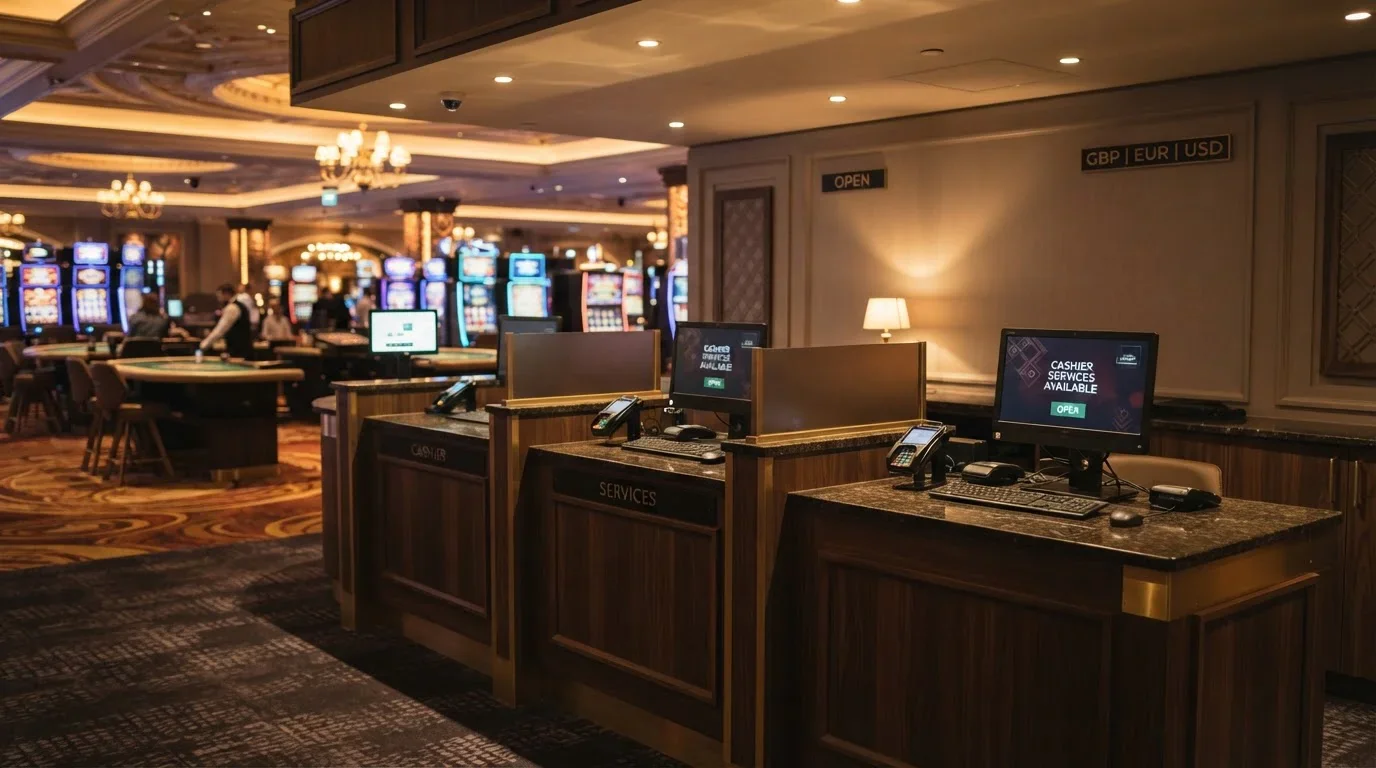
The answer splits cleanly in two. No UKGC-licensed online casino accepts paper cheques or banker’s drafts in 2026—licence condition 5.1.2 closed that door on 31 January 2024. Walk into a licensed land-based casino with the same cheque, and the cage will take it, run identity checks, deposit it with the venue’s bank, and credit your account once it clears in two business days. Same instrument, two outcomes, and the channel makes all the difference.
This page gives you the named venues where cheques still work—Grosvenor’s 50-venue estate, Genting’s national reach and Mayfair premium rooms, Empire Leicester Square’s high-stakes cage, the Hippodrome’s 24/7 no-membership access, Les Ambassadeurs and Aspinalls for the ultra-high-net-worth segment, and regional independents outside London. You will learn what happens when you hand a cheque to a cashier, which identity and source-of-funds checks apply under Money Laundering Regulations 2017, how long clearing takes under the Image Clearing System, when your funds become playable, and why every affiliate table listing 888casino, William Hill, and Bet365 as cheque-friendly is wrong.
If you cannot use a cheque online, you need the bank-rail method that replaced it: Faster Payments, Open Banking, debit card, CHAPS for very large sums. The use case is identical—large deposits, no card details shared, money moving straight from your bank account—but the instrument is electronic, not paper, so it qualifies as a payment service under the Payment Services Regulations 2017. That is the statutory line the page will document.
The cheque is not dead in UK gambling. It moved from the online cashier to the land-based cage, and this is the routing guide for 2026.
Table of Contents
- Can You Deposit by Cheque at a UK Online Casino in 2026?
- UK Casinos That Accept Bank Cheques—Land-Based Venues Only
- How Cheque Deposits Work at a UK Casino Cage
- What Replaced Cheques at Online Casinos—Bank-Rail Alternatives
- The Risk of Sites Advertising Cheque Deposits in 2026
- Why Cheques Declined in the UK—Volume Data and Economics
- Banker’s Draft vs. Personal Cheque—What’s the Difference?
- Responsible Gambling and Safer Play
Can You Deposit by Cheque at a UK Online Casino in 2026?
No. Not at 888casino, not at William Hill, not at Ladbrokes, Bet365, Grosvenor online, Sky Vegas, LeoVegas, or any other GB-facing remote operator holding a UKGC licence. The prohibition is uniform, statutory, and has been in force since 31 January 2024 under licence condition 5.1.2 of the LCCP.
Every affiliate table you have seen listing these brands as cheque-accepting is either stale (pre-2024 content never updated) or outright fabricated. The reader leaves those pages with a false operator list and no idea whether a cheque works today. Here is what actually happened and why.
Why Online Casinos Stopped Accepting Cheques—UKGC Licence Condition 5.1.2
Licence condition 5.1.2, titled "Payment methods and services," applies to all remote casino, bingo, and betting operating licences, except ancillary, host, and remote betting intermediary trading-room-only licences. The condition became effective on 31 January 2024. It reads:
Licensees must only accept payment from customers using their gambling facilities in Great Britain by a method which involves the provision of payment services as defined in Schedule 1 Part 1 of the Payment Services Regulations 2017 (SI 2017 No 752) if the provider of those services is a ‘payment service provider’ within the definition of that term in regulation 2 of those Regulations (or the equivalent requirements of any UK Statutory Instrument by which those regulations are amended or superseded).
The operative phrase: "by a method which involves the provision of payment services." A paper cheque or banker’s draft does not involve the provision of a payment service. Schedule 1 Part 2 of the Payment Services Regulations 2017, paragraph 2(g), explicitly excludes from the definition of payment services:
payment transactions based on any of the following documents drawn on the payment service provider with a view to placing funds at the disposal of the payee—(i) paper cheques of any kind, including traveller’s cheques; (ii) bankers’ drafts; (iii) paper-based vouchers; (iv) paper postal orders.
A paper cheque is a paper instrument drawn on a bank. It is not an electronic fund transfer. The Payment Services Regulations 2017 were designed to regulate electronic payment methods—direct debits, debit cards, credit transfers, card schemes, mobile payments, money remittance. Paper instruments fall outside that scope by express exclusion.
Because paper cheques are not payment services, and LC 5.1.2 permits only payment services, every UKGC-licensed remote operator is barred from accepting them. There is no discretion, no "on request" hedge, no venue-by-venue exception. The rule is binary.
The Payment Services Regulations 2017: Paper Cheques Are Not a Payment Service
The Payment Services Regulations 2017 came into force on 26 June 2017, transposing the EU’s Second Payment Services Directive into UK law. The directive focused on electronic means of payment—direct debit, debit card, credit card, standing order, mobile payments, and money remittance services. It did not apply to cash-only transactions or paper cheque-based transfers.
Schedule 1 Part 1 of the PSR 2017 defines what constitutes a payment service: services enabling cash deposits and withdrawals from payment accounts, execution of payment transactions (credit transfers, direct debits, card payments), card issuing, merchant acquiring, and money remittance. Schedule 1 Part 2 lists exclusions—transactions that look like payments but fall outside the regulatory framework. Paragraph 2(g) names paper cheques, bankers’ drafts, paper-based vouchers, and paper postal orders.
The exclusion is intentional. Paper cheques clear through a separate infrastructure—Pay.UK’s Image Clearing System for the UK—outside the electronic payment rails that the PSR 2017 regulates. The cheque is a paper instruction to a bank to transfer funds, not a service provided by a payment service provider. The payer writes the cheque, the payee deposits it with their bank, the banks exchange images and settle, but no FCA-authorised payment service provider sits in the middle delivering a regulated payment service.
That distinction is the hinge. LC 5.1.2 requires remote operators to accept payment only by methods that are payment services delivered by FCA-authorised or registered payment service providers. Paper cheques fail both tests: they are not payment services under the statutory definition, and no FCA-authorised PSP delivers them. So they cannot be used at the online cashier.
What Changed on 31 January 2024
The 31 January 2024 effective date of LC 5.1.2 represents a formalisation of existing policy rather than a new prohibition. Remote operators had already moved away from cheques by 2020–2022 as digital-only payment strategies aligned with the PSR 2017 framework. The updated licence condition made the rule explicit and future-proof by referencing the statutory definition rather than listing approved methods.
Before LC 5.1.2, the UKGC’s payment-method guidance was less prescriptive. Operators could theoretically accept cheques if they implemented appropriate controls, though in practice the clearing time (six weekdays under the old paper system, two business days after 2019’s Image Clearing System rollout) made cheques commercially unviable compared to instant bank transfers and card deposits. The regulatory nudge was toward speed, digital integration, and real-time affordability monitoring—all incompatible with paper instruments.
The January 2024 update crystallised the position: only methods qualifying as payment services under PSR 2017 are permitted. The change was consultation-driven. The UKGC published a consultation in late 2023 on proposed amendments to the LCCP, including the payment-methods condition. The majority of respondents agreed or strongly agreed with the update. A small minority raised concerns that the wording might not account for future payment innovations or overseas payment methods not FCA-licensed in the UK, but the UKGC proceeded with the wording as proposed, noting that the "or the equivalent requirements of any UK Statutory Instrument by which those regulations are amended or superseded" clause future-proofs the condition against legislative changes.
The result: from 31 January 2024 onward, any GB-facing remote operator accepting a paper cheque or banker’s draft is in breach of LC 5.1.2 and exposed to compliance action, fines, licence suspension, or revocation. No UKGC-licensed online casino does it.

Can I deposit by cheque at a UK online casino in 2026?
No. UKGC licence condition 5.1.2, effective 31 January 2024, bars all GB-facing remote operators from accepting paper cheques or banker’s drafts because these instruments are excluded from the definition of payment services under Schedule 1 Part 2, paragraph 2(g) of the Payment Services Regulations 2017. Every online casino licensed by the UKGC—888casino, William Hill, Ladbrokes, Bet365, Grosvenor online, and all others—cannot accept cheques. Land-based casinos operate under different rules and still accept cheques at the cage.
Why did online casinos stop accepting cheques?
Online casinos stopped accepting cheques because UKGC licence condition 5.1.2 (effective 31 January 2024) permits only payment methods that qualify as "payment services" under the Payment Services Regulations 2017, delivered by FCA-authorised providers. Paper cheques are explicitly excluded from the PSR 2017 definition of payment services (Schedule 1 Part 2, paragraph 2(g)), so they cannot be used at any UKGC-licensed online cashier. The rule is statutory, not discretionary.
Can I post a cheque to fund my Grosvenor or Bet365 account?
No. Grosvenor’s online arm (Rank Interactive, UKGC licence 42927) and Bet365 (Hillside New Media, UKGC licence 37711) are remote operators subject to LC 5.1.2, which bars paper cheques. You cannot post a cheque to fund an online account at either operator. Grosvenor’s land-based venues have cages that accept cheques in person, but the online account and the land-based cage are operationally separate. Bet365 has no land-based venues in the UK.
UK Casinos That Accept Bank Cheques—Land-Based Venues Only
Licence condition 5.1.1 of the LCCP, titled "Cash and cash equivalents," applies to non-remote (land-based) casino licences. It permits acceptance of "bankers drafts, cheques and debit cards and digital currencies" as cash equivalents, provided the licensee has "appropriate policies and procedures" to mitigate money-laundering and terrorist-financing risks, documented in a risk assessment.
The key difference: LC 5.1.1 does not reference the Payment Services Regulations 2017. Non-remote operators are not bound by the PSR 2017 definition of payment services because the transaction happens at the cage in person, not through a remote electronic payment system. The cheque or banker’s draft is handed over face-to-face, identity is verified on the spot, and the funds clear through the same Image Clearing System whether the deposit is at a casino cage or a high-street bank branch.
The trade-off: land-based casinos must implement Money Laundering Regulations 2017 controls. That means customer due diligence under regulation 28 (identity verification, understanding the nature and purpose of the business relationship) and enhanced due diligence under regulation 33 for transactions that are complex, unusually large, or present higher risk. In practice, if you walk into a Grosvenor cage with a £10,000 banker’s draft and you are a new customer, you will hand over photo ID, proof of address, and documents showing the source of the funds—a recent bank statement, payslip, inheritance documentation, property-sale completion, or investment-account statement. The casino will not make the funds playable until those checks are satisfied, even if the cheque has cleared.
Here are the UK land-based casinos that accept cheques and banker’s drafts at the cage in 2026, with specifics on what each venue offers, who they suit, and what distinguishes them.

| Casino | Location | Membership Required | Typical Minimum | Clearing Time | Best For |
|---|---|---|---|---|---|
| Grosvenor Casinos | 50+ venues nationwide | No | £100 | 2 business days | Widest geographic coverage, accessible entry point |
| Genting Casinos UK | 33 venues (London, regional cities, Mayfair clubs) | No (most venues); members-only (Mayfair clubs) | £100–£500 (venue-dependent) | 2 business days | National reach plus premium London segment |
| Empire Casino, Leicester Square | 5-6 Leicester Square, London | No | £500–£1,000 (high-stakes profile) | 2 business days | Premium West End, routine six-figure deposits |
| The Hippodrome Casino | Cranbourn Street, Leicester Square, London | No | £100–£500 | 2 business days | 24/7 operation, most accessible London option |
| Les Ambassadeurs Club | 5 Hamilton Place, Mayfair, London | Yes (members-only, by introduction) | No stated minimum (six-figure routine) | 2 business days | Ultra-high-net-worth apex, banker’s drafts at scale |
| Aspinalls (Wynn Mayfair) | 27-28 Curzon Street, Mayfair, London | Yes (members and guests) | Not publicly stated | 2 business days | Private premium small-room intimacy, Curzon Street |
| Park Lane Club & Regional Independents | 22 Park Lane (London); Napoleons (Northern England/Midlands); others | Varies by venue | £100–£500 | 2 business days | Regional coverage outside national chains |
Grosvenor Casinos—Largest UK Estate, 50+ Venues
Grosvenor Casinos, owned by Rank Group plc, operates the largest UK land-based casino estate by venue count—approximately 50 venues, roughly 45% of all UK casino venues. The brand carries over from Rank’s high-street betting shops and Mecca Bingo halls, so name recognition is strong. Venues span England, Scotland, and Wales: London (multiple sites including Park Lane, Piccadilly, The Victoria), Birmingham, Manchester, Leeds, Edinburgh, Glasgow, Cardiff, Southampton, Portsmouth, Reading, Luton, Dundee, Aberdeen, Blackpool, Bolton, Walsall, and others.
Each venue has a cage (cashier’s desk) operating during venue hours, commonly 12pm to 6am the next day, though hours vary by location. The cage accepts cash, debit card, cheque, and banker’s draft for deposits into a player account or chip purchase. Minimum cheque value is typically £100—some venues decline lower amounts due to processing cost versus risk. Identity verification applies: photo ID (passport, driving licence) required for first deposit or for amounts triggering Money Laundering Regulations 2017 checks. Source-of-funds documentation is requested for deposits above internal thresholds, commonly £5,000 to £10,000 for new or infrequent customers. Established players with documented profiles face higher thresholds.
Grosvenor’s online arm, Grosvenor.com, operates under a separate UKGC licence (Rank Interactive, UKGC 42927) and is subject to LC 5.1.2, so it cannot accept cheques. The land-based cage and the online account sit under the same brand umbrella but are operationally separate. Some venues allow a cage deposit to be credited to the same customer profile if membership links the accounts, but you cannot post a cheque to fund the online account—the transaction must happen in person at a land-based venue.
The Grosvenor estate is the most accessible option for a reader holding a cheque outside London. Geographic coverage is unmatched among UK casino operators. Walk into the nearest venue with your cheque, photo ID, and (if depositing a large sum) source-of-funds documentation, and the cage will process it. Clearing time is two business days under the Image Clearing System. Some venues credit funds immediately to your account for play, with the caveat that if the cheque bounces you are liable; others hold until clearing is confirmed.
Genting Casinos UK—National Reach and Mayfair Premium
Genting Casinos UK Limited (Company No. 01519689, UKGC licence 537) is the UK subsidiary of the Malaysian-based Genting Group. It operates 33 licensed premises under the Genting Casinos and Genting Electric brands, plus three Mayfair clubs: Colony Club at 24 Hertford Street, Palm Beach at 30 Berkeley Street, and Maxims at 14 Coventry Street. The October 2026 opening of the Trocadero development at Coventry Street / Piccadilly adds a marquee West End venue—37,000 square feet total, 16,000 square feet of gaming floor, 24-hour operation, restaurants and bars, positioned to compete directly with the Hippodrome and Empire Leicester Square.
The national estate includes Birmingham (Chinatown and Resorts World, the latter part of an integrated resort with hotel, dining, and cinema), Manchester Portland Street, London Cromwell Road, Edinburgh Fountain Park, Glasgow, Brighton, Margate, Sheffield, Plymouth, Liverpool Renshaw Street, Leicester, Wirral, Luton, Derby, Stoke, Wolverhampton, Southampton, Torquay, Great Yarmouth, Southend, Reading, Westcliff, and others. Each venue’s cage accepts cheques and banker’s drafts during operating hours, commonly 2pm to 6am, varying by venue; some operate 24 hours.
Mayfair clubs cater to a higher-stakes segment. Banker’s drafts are more common than personal cheques at Colony, Palm Beach, and Maxims because the clientele routinely deposits six-figure sums and the bank-guaranteed instrument eliminates bounce risk. Source-of-funds and source-of-wealth checks at these venues are tailored to the ultra-high-net-worth profile—expect detailed financial vetting, but the thresholds are higher than at regional Genting venues. A £50,000 banker’s draft at Colony Club triggers less scrutiny than the same amount at Genting Stoke because the venue’s risk appetite and customer base differ.
Genting’s positioning is national reach with a premium London option under one licence. Resorts World Birmingham integrates the casino with leisure and hospitality, so the brand is associated with destination venues rather than standalone gaming floors. The Trocadero opening in October 2026 adds premium West End capacity at a time when Crockfords (30 Curzon Street, Mayfair) has closed and competition for high-roller custom is consolidating around a few flagship sites.
Minimum cheque values vary by venue. Regional sites commonly set £100 to £500 minimums. Mayfair clubs do not publish minimums because the clientele does not deposit £100 cheques. Clearing time is two business days across the estate, with playability depending on source-of-funds checks.
Empire Casino, Leicester Square—High-Stakes West End Flagship
Empire Casino at 5-6 Leicester Square, London WC2H 7NA, is the flagship of Metropolitan Gaming’s 11-venue portfolio (UK and Egypt). The venue operates 24 hours, commonly opening at 2pm and running through to 6am the next day, with a large multi-level gaming floor, premium table limits, and dedicated high-roller salons. Leicester Square places it at the heart of the West End tourist and entertainment district, alongside the Hippodrome (Cranbourn Street, one block away) and the new Genting Trocadero. The three venues form what developers describe as a "London Strip" of casinos.
Empire’s positioning is high-stakes. Routine business includes six-figure banker’s drafts, not £500 personal cheques. The cage accepts both, but the venue’s risk appetite, table limits, and clientele profile tilt toward serious money. If you walk in with a £10,000 banker’s draft, source-of-funds checks are standard for new customers above £5,000, but the staff will not blink—that is a Tuesday at Empire. Walk in with a £200 personal cheque, and you will be asked for ID and the cheque will be accepted, but the venue is not optimised for that segment.
The premium/high-stakes focus distinguishes Empire from Grosvenor’s mass-market accessibility and from the Hippodrome’s 24/7 no-membership tourist-friendly model. Empire caters to players who fund large gambling sessions with banker’s drafts because card limits are too low or because they prefer not to share card details for five-figure deposits. The cage is equipped for it.
Identity verification and source-of-funds documentation apply under Money Laundering Regulations 2017. For deposits above £5,000 from new or infrequent customers, expect to provide photo ID, proof of address, and recent bank statements, payslips, or other documents showing the origin of the funds. Clearing time is two business days. The venue may credit funds immediately for play if the customer profile supports it, or hold until clearing is confirmed.
Metropolitan Gaming operates other UK venues, but Empire Leicester Square is the relevant one for this page because it is the West End location where banker’s drafts for five- and six-figure sums are more common than at regional Grosvenor or Genting sites. The venue is not members-only—walk in if you are over 18—but the table minimums, salon access, and overall atmosphere are geared toward higher-stakes play.
The Hippodrome Casino, London—24/7 Access, No Membership Required
The Hippodrome Casino occupies a historic building at Cranbourn Street, Leicester Square, London WC2H 7JH—the former Talk of the Town theatre, Matcham-designed, dating to 1900. The current casino operation launched in 2012. The gaming floor spans 16,000 square feet across multiple levels. The venue operates 24/7, open to the public (over-18s), no membership required for entry. The cage is open during all operating hours.
The cage accepts cash, debit card, cheque, and banker’s draft. Minimum cheque value is not publicly stated; industry norm at venues of this scale is £100 to £500. Source-of-funds checks apply under Money Laundering Regulations 2017 for large or unusual deposits. The Hippodrome also operates an online casino (hippodromecasino.com, UKGC licence 039372-R-319367-026, dual-licensed with Malta MGA/B2C/130/2006) under a separate remote licence, subject to LC 5.1.2, so the online arm cannot accept cheques. The land-based cage and the online account are operationally separate.
The Hippodrome’s distinguishing feature is 24/7 no-membership accessibility. Les Ambassadeurs and Aspinalls are members-only by introduction. Empire and the Mayfair Genting clubs tilt toward higher-stakes players. Grosvenor has the widest national coverage but most venues close at 6am. The Hippodrome is always open, centrally located in Leicester Square, and has no membership barrier. Walk in with a cheque, present ID at the cage, and the transaction proceeds. That makes it the most accessible named option for a London visitor or resident holding a cheque.
The venue’s positioning is entertainment destination rather than exclusive gaming club. The building’s history (former theatre, cabaret venue) carries through in the layout and atmosphere. Table games, slots, poker room, restaurants, bars, and live entertainment share the space. The cage processes cheques as routine business but the venue is not optimised exclusively for high-roller banker’s drafts the way Les A or Empire are.
Clearing time is two business days under the Image Clearing System. The Hippodrome may credit funds immediately to your account for play with the caveat that you are liable if the cheque bounces, or hold until clearing is confirmed depending on the customer profile and deposit amount. Photo ID (passport, driving licence) is required. For deposits above internal thresholds (commonly £5,000 to £10,000 for new customers), source-of-funds documentation is requested.
Les Ambassadeurs Club, Mayfair—Members-Only Ultra-High-Net-Worth
Les Ambassadeurs Club at 5 Hamilton Place, Mayfair, London W1J 7ED, is the apex of UK private gaming. The club occupies one of the finest Georgian properties in Mayfair, on a quiet corner off Park Lane. Established in 1941, it moved to the current location in 1950. Le Cercle gaming club was established at the venue in 1961 under the Betting and Gaming Act 1960. The club is part of Ambassadeurs Group and holds a UKGC non-remote casino licence.
Membership is by introduction or significant deposit. The membership fee is not publicly stated but understood to be in five figures. Prospective members undergo financial vetting as part of the application process, so source-of-funds and source-of-wealth checks are built into membership itself. Once you are a member, the cage accepts banker’s drafts and cheques without the transaction-by-transaction scrutiny a new customer at a public venue faces, because the club already knows your financial profile.
The club operates 24/7 for members and their guests. Private gaming rooms run roulette, blackjack, and three-card poker. Fine dining is available in the members’ restaurant. The minimum deposit is not stated because the clientele does not deposit £500 cheques—this segment routinely handles six- and seven-figure sums. Banker’s drafts are preferred over personal cheques for large amounts because they are bank-guaranteed (funds already drawn from the payer’s account when the draft is issued), eliminating bounce risk and signalling serious intent.
Known clientele includes Middle Eastern high-rollers, UK titled families, international business owners, football managers (Alex Ferguson is a member), agents (Pini Zahavi), and entrepreneurs (Philip Green, Robert and Vincent Tchenguiz per press reports). Historical anecdotes document the scale: Philip Green won £2 million at roulette in 2004; the Earl of Derby lost £165,000 in one evening in the 1960s. These are not apocryphal stories—they appeared in the Evening Standard and are cited in the club’s Wikipedia entry and parliamentary evidence submissions.
Les Ambassadeurs is not an option for a casual reader holding a £500 cheque and looking for a venue to deposit it. It is included here because it is the highest-profile venue in the UK where banker’s drafts still genuinely move money at scale, and because the question "which Mayfair casinos accept cheques" has a concrete answer: Les A does, but only for members. Clearing time is two business days. Playability is immediate for established members with documented profiles; the club’s risk appetite and customer base mean that a £100,000 banker’s draft from a known member does not trigger the same hold that it would at a regional Grosvenor venue for a new customer.
Ambassadeurs Group also operates Les A Online, a remote arm under a separate UKGC licence. The online casino cannot accept cheques per LC 5.1.2. The land-based club and the online site are operationally separate.
Aspinalls (Wynn Mayfair), Curzon Street—Private Premium Gaming
Aspinalls Club Limited, now branded Wynn Mayfair, operates at 27-28 Curzon Street, Mayfair, London W1J 7TJ, under UKGC licence 2142. The club was originally founded by John Aspinall; the Wynn branding reflects a more recent ownership change. It is a members-only venue (members and their guests), not open to the public, with hours listed as 12pm to 6am in current guides.
The positioning is small-room intimacy rather than large gaming floor. The venue offers premium gaming in a private setting, with Parlay restaurant and bar for members. The Grade II listed building underwent phased refurbishment. Membership is described as "free" compared to Les Ambassadeurs’ high-fee structure, but access is by introduction or application with a financial profile, so the barrier is vetting rather than an upfront fee.
The cage accepts cheques and banker’s drafts from members during operating hours. Minimum values and source-of-funds thresholds are not publicly stated. The venue sits on Curzon Street, the same street where Crockfords operated at number 30 until its closure in October 2023. Aspinalls/Wynn is the surviving Curzon Street gaming venue, and the address carries Mayfair cachet.
The club is a tier below Les Ambassadeurs in exclusivity and scale—one venue versus Les A’s single flagship, free membership versus five-figure fees, 12pm-6am hours versus 24/7 availability—but it is still a high-net-worth segment. The small-room model appeals to players who prefer intimate private gaming over the larger floors at Genting or the Hippodrome. Clearing time for cheques is two business days. Identity verification and source-of-funds checks apply under Money Laundering Regulations 2017, though members are vetted at application so transaction-level checks are less intrusive than for new customers at public venues.
Park Lane Club and Regional Independents—Napoleons, Smaller Venues
Park Lane Club at 22 Park Lane, London W1K 1BE, is a members-only West End venue known for late closing (past the standard 6am) and a rooftop terrace where gaming is available—unique in London. Private salons run baccarat, blackjack, and roulette. Hours are not publicly stated but the venue operates later than most. The club is not part of the Grosvenor or Genting national chains; it is an independent operator under a UKGC non-remote licence. The cage accepts cheques and banker’s drafts from members, with policies discretionary and not publicly documented.
Napoleons Casinos operates six-plus UK venues concentrated in Northern England and the Midlands: Bradford, Hull, Leeds, Middlesbrough, Sheffield, and Leicester are confirmed locations. Each venue has a cage that accepts cash, debit card, cheque, and banker’s draft. Minimum cheque values are commonly £100 to £500, venue-dependent. Source-of-funds thresholds are set by each venue’s risk assessment under Money Laundering Regulations 2017. Napoleons is a regional alternative for readers holding cheques in Northern England or the Midlands who do not want to travel to London or to the nearest Grosvenor venue.
Other regional independents operate under individual UKGC non-remote licences across the UK. Each holds a premises licence listed in the UKGC public register. Cage policies are venue-specific. Cheque acceptance is discretionary but permitted under LC 5.1.1, so most venues will take a cheque or banker’s draft provided identity and source-of-funds checks are satisfied. Minimum values, clearing procedures, and playability timelines vary.
The independent and regional venue category provides geographic coverage outside the London-centric options (Empire, Hippodrome, Les A, Aspinalls, Park Lane) and outside the Grosvenor/Genting national chains. If you hold a cheque in Hull, Middlesbrough, or Leicester, Napoleons is closer than the nearest Grosvenor. If you are in London and prefer a late-closing venue with rooftop gaming, Park Lane is an option, though membership is required.
Clearing time across all regional independents is two business days under the Image Clearing System. Identity verification (photo ID) and source-of-funds documentation apply for large or unusual deposits. The £100 to £500 minimum range is typical, with some venues declining smaller cheques due to processing cost versus risk.
Which UK casinos still accept bank cheques?
UK land-based casinos accept cheques and banker’s drafts at the cage under LCCP condition 5.1.1, subject to Money Laundering Regulations 2017 controls. Named venues: Grosvenor Casinos (50+ nationwide), Genting Casinos UK (33 venues including Mayfair clubs), Empire Casino Leicester Square, The Hippodrome Casino London, Les Ambassadeurs Club Mayfair (members-only), Aspinalls/Wynn Mayfair (members-only), Park Lane Club London, Napoleons Casinos (Northern England/Midlands), and other regional independents. No UKGC-licensed online casino accepts cheques in 2026 due to LC 5.1.2.
Do I need to be a member to deposit a cheque at a Mayfair casino?
It depends on the venue. Les Ambassadeurs Club (5 Hamilton Place) and Aspinalls/Wynn Mayfair (27-28 Curzon Street) are members-only and require membership or guest access to enter and use the cage. Genting’s Mayfair clubs (Colony Club, Palm Beach, Maxims) under the same UKGC licence 537 are part of the Genting estate; membership policies vary by venue but most Genting sites are open to the public. The Hippodrome and Empire are in or near Mayfair/West End, open to the public, no membership required.
How Cheque Deposits Work at a UK Casino Cage
You walk into a licensed land-based casino with a cheque or banker’s draft, hand it to the cage cashier, provide identification, and the transaction begins. What follows depends on the amount, your history with the venue, and the venue’s risk profile under Money Laundering Regulations 2017. Small sums from known customers move quickly. Large sums from new customers trigger enhanced due diligence. This section walks through the procedure, the checks, the clearing timeline, and when your funds become playable.

Step-by-Step: Depositing a Cheque at the Cashier’s Desk
Arrive at the casino during operating hours. Most land-based venues open around 12pm or 2pm and close at 6am the next day; some operate 24 hours (Hippodrome, Genting Trocadero from October 2026). Walk to the cage (cashier’s desk). Present your cheque or banker’s draft and state that you want to deposit it.
The cashier will ask for photo identification—passport, UK driving licence, or national identity card if you are not a UK resident. First-time visitors always provide ID. Returning customers may not be asked if the venue recognises you and you are depositing within previously established limits. If you do not have a player account or membership at the venue, the cashier will create one, recording your name, address, date of birth, and identification details.
The cashier inspects the cheque. It must be made payable to the casino or to you (if payable to you, you endorse it by signing the back). The cheque must be dated, signed by the payer, and drawn on a UK bank. Post-dated cheques (dated in the future) are not accepted. The amount must be legible. If the cheque is a banker’s draft, the cashier verifies that it is issued by a UK bank and that it names the payee (you or the casino).
The cashier records the deposit: cheque number, payer name (if not you), bank sort code and account number (from the cheque), amount, date. You sign a deposit slip or the casino’s records acknowledging the transaction. The cashier provides a receipt showing the deposit amount, the date, and a reference number.
The cheque is then deposited with the casino’s bank. The casino’s bank submits it to Pay.UK’s Image Clearing System. The scanned image is sent to the payer’s bank. The payer’s bank debits the payer’s account and confirms to the payee’s bank. The casino’s bank credits the casino. Two business days after deposit (if deposited before the bank’s cut-off time, commonly 15:30 to 17:00), the cheque clears.
Once cleared, the casino credits your player account or issues chips. If you requested immediate play and the venue’s policy allows it, the casino may credit your account before clearing, with the caveat that you are liable if the cheque bounces. If the cheque dishonours (insufficient funds, stopped, forged), the casino reverses the credit and pursues recovery from you.
Identity Verification and Source-of-Funds Checks Under MLR 2017
Money Laundering, Terrorist Financing and Transfer of Funds (Information on the Payer) Regulations 2017 require casinos to apply customer due diligence (CDD) under regulation 28 and enhanced customer due diligence (ECDD) under regulation 33 depending on the risk profile of the transaction and customer.
Standard CDD (regulation 28): The casino must identify you and verify your identity using reliable, independent sources. Photo ID satisfies this—passport, driving licence, national ID card. The casino must also understand the nature and purpose of the business relationship. For a straightforward cheque deposit at a public venue, this is minimal: you are depositing funds to gamble. The casino records your details in its customer file.
Enhanced CDD (regulation 33): The casino must apply ECDD where the transaction is complex, unusually large, or presents higher risk. A cheque or banker’s draft is a cash equivalent, so deposits above a certain threshold trigger ECDD. Thresholds vary by venue. Common figures: £2,000 to £5,000 for enhanced scrutiny, £5,000 to £10,000 for full source-of-funds documentation at public venues like Grosvenor or Genting regional sites. High-roller venues (Empire, Les A, Aspinalls, Mayfair Genting clubs) set higher thresholds because their customer base routinely deposits six figures.
Source-of-funds documentation: If your deposit triggers ECDD, the casino asks you to provide documents showing the origin of the money. Acceptable documents:
- Recent bank statement (last one to three months) showing the funds in your account before you wrote the cheque or obtained the banker’s draft.
- Payslip (if the funds come from employment income).
- P60 or tax return (if you are self-employed or the sum is large enough to require annual income verification).
- Inheritance documentation (if the funds come from an estate—copy of the will, probate grant, solicitor’s letter).
- Property-sale completion statement (if the funds come from selling a property).
- Investment-account statement or portfolio valuation (if the funds come from liquidating investments).
- Pension statement (for retired players funding from pension income or lump sums).
The casino reviews the documents. If satisfied, it approves the deposit and makes the funds playable once the cheque clears. If not satisfied, it holds the funds pending further information or declines the deposit and returns the cheque.
Politically exposed persons (PEPs): If you are a PEP or a close relative or associate of a PEP, regulation 35 of MLR 2017 requires the casino to apply ECDD, including source-of-wealth checks (not just source of funds). Source of wealth is broader: how you accumulated your overall wealth, not just where this specific deposit came from. The casino will ask for documents showing your financial history—career income, business ownership, inheritance, investments.
The checks are proportionate to the risk. A £500 cheque from a regular customer at a Grosvenor venue in Bolton requires photo ID and no source-of-funds documentation. A £50,000 banker’s draft from a new customer at Empire Leicester Square requires photo ID, proof of address, and detailed source-of-funds documentation showing where the £50,000 came from. A £200,000 banker’s draft from a first-time visitor to Les Ambassadeurs triggers source-of-wealth checks as part of the membership application process, so by the time you are handing over the draft, the club already knows your financial profile.
UK Cheque Clearing Time—The Image Clearing System Explained

Pay.UK’s Image Clearing System (ICS) launched in 2019, replacing the paper-based clearing system that took six weekdays. Under ICS, sterling cheques drawn on UK bank accounts clear digitally in two business days.
The timeline: if you deposit a cheque at a casino cage on Monday before the venue’s bank cut-off time (commonly 15:30 to 17:00, depending on which bank the casino uses), the cheque enters the clearing cycle on Monday. The casino’s bank scans the cheque and submits the image to Pay.UK’s ICS. The image is routed to the payer’s bank on Monday evening. The payer’s bank debits the payer’s account overnight and confirms to the casino’s bank by Tuesday end of business. The casino’s bank credits the casino’s account by Wednesday 23:59 at the latest. Two business days: Monday deposit, Wednesday cleared.
If you deposit after the cut-off time on Monday, the cheque does not enter the cycle until Tuesday, so clearing completes by Thursday. Weekends and bank holidays do not count as business days. A cheque deposited Friday before cut-off clears by Tuesday (Friday → Monday → Tuesday, two business days). A cheque deposited Saturday is treated as deposited Monday and clears Wednesday.
Post Office deposits add at least one extra day. If you pay a cheque into your bank account at a Post Office counter, the Post Office couriers the cheque to your bank before the bank enters it into ICS. A cheque deposited at a Post Office on Monday may not reach your bank until Tuesday, so it enters ICS on Tuesday and clears by Thursday—three calendar days rather than two. Casinos do not accept cheques at Post Offices; you deposit directly at the cage, so this delay does not apply to casino deposits.
Bounce window: If the payer’s bank dishonours the cheque (insufficient funds, signature mismatch, stopped payment, account closed, suspected fraud), the cheque bounces. The payer’s bank notifies the casino’s bank, commonly within the two-day clearing window or shortly after. The casino’s bank reverses the credit. The casino reverses your account credit and pursues recovery. You are liable for any shortfall if you gambled the funds before the cheque bounced.
Banker’s drafts are bank-guaranteed, so they do not bounce in the same way a personal cheque can. The funds are already drawn from the payer’s account when the draft is issued. The draft can still be stopped if it is reported lost or stolen, or if the bank suspects fraud, but the risk is much lower than with a personal cheque. That is why high-roller venues prefer banker’s drafts for six-figure deposits.
When Your Funds Become Playable: Cleared vs. Available
"Cleared" and "playable" are not the same. A cheque clears when the payer’s bank confirms funds to the casino’s bank—two business days after deposit. The funds become playable when the casino makes them available in your account or issues chips, which may be before, at, or after clearing depending on the venue’s policy and your risk profile.
Immediate play, pre-clearing: Some venues credit your account immediately after you deposit the cheque, before clearing. You can gamble the funds on day one. The caveat: if the cheque bounces, you are liable. The casino reverses the credit and pursues recovery from you. If you lost the funds gambling, you still owe the casino the bounced amount. This policy is common for small sums (£100 to £500) from known customers at public venues. It is rare for large sums from new customers.
Hold until clearing: Other venues hold the funds until clearing is confirmed—two business days. You deposit the cheque on Monday, it clears Wednesday, the casino credits your account Wednesday evening or Thursday morning. You cannot gamble the funds until then. This policy is common for large sums, new customers, or venues with lower risk appetite.
Hold until clearing plus source-of-funds approval: If your deposit triggers ECDD and the casino requests source-of-funds documentation, the hold extends until both clearing and document review are complete. You deposit a £10,000 banker’s draft on Monday, it clears Wednesday, but the casino requested bank statements and you submitted them Tuesday evening. The compliance team reviews them Wednesday and Thursday. Approval comes Friday. Your funds become playable Friday, even though clearing completed Wednesday. This is the "cleared vs. playable" gap in action.
The gap can be one to three business days for routine ECDD. If the casino requests additional documents or escalates the review to senior management (common for very large sums or complex source-of-funds scenarios), the gap extends. A £100,000 banker’s draft from a new customer at Les Ambassadeurs may take a week from deposit to playable funds because the club conducts detailed source-of-wealth checks even though the draft itself clears in two days.
Ask the cashier at deposit what the venue’s policy is. If you need immediate play, state that when you hand over the cheque. The cashier will tell you whether the venue credits pre-clearing and under what conditions. If you are depositing a large sum and you are a new customer, expect a hold until both clearing and ECDD are complete.
How long does a cheque take to clear at a UK casino?
Two business days under Pay.UK’s Image Clearing System. If you deposit a cheque at a casino cage on Monday before the venue’s bank cut-off time (commonly 15:30 to 17:00), the cheque clears by Wednesday 23:59. Weekends and bank holidays do not count. When your funds become playable depends on the casino’s policy: some venues credit immediately before clearing (with bounce-risk liability on you), others hold until clearing is confirmed, and large deposits triggering source-of-funds checks may be held until both clearing and compliance approval are complete.
What documents do I need to deposit a cheque at a land-based casino?
Photo ID (passport, driving licence, or national ID card) is required for all cheque deposits. For large or unusual deposits triggering enhanced due diligence under Money Laundering Regulations 2017 (commonly £5,000 to £10,000 at public venues, higher at high-roller venues), you must also provide source-of-funds documentation: recent bank statements, payslips, P60, inheritance documents, property-sale completion, investment-account statements, or pension statements showing where the money came from. Thresholds and requirements vary by venue.
What Replaced Cheques at Online Casinos—Bank-Rail Alternatives
If you cannot use a cheque at a UKGC-licensed online casino, you need the method that does the cheque’s job electronically: moving large sums from your bank account to the casino without sharing card details. The use case has not disappeared—players still fund five-figure deposits, still prefer not to expose card numbers online for those amounts, still want direct bank-account debits. The instrument changed from paper to electronic, which is why it qualifies as a payment service under PSR 2017 and why LC 5.1.2 permits it.
Here are the bank-rail methods that replaced cheques at the online cashier, with the operators that accept them, the speed, the limits, and when each method fits.

| Method | Speed | Typical Limits (per transaction) | Shares Card Details? | Best For |
|---|---|---|---|---|
| Faster Payments / Open Banking | Instant (seconds) | £10 min, £10,000–£100,000 max | No | Large deposits, instant settlement, 24/7 availability |
| Debit Card (Visa, Mastercard, Maestro) | Instant | £5–£10 min, £5,000–£25,000 max | Yes (but from current account like a cheque) | Universal acceptance, closed-loop withdrawals |
| PayPal | Instant | £10 min, £10,000 max | No (intermediate account) | Adds a layer between bank and casino |
| Skrill / Neteller | Instant | £10 min, £10,000–£50,000 max | No (e-wallet funded by bank transfer or card) | Frequent players, multiple-casino convenience |
| CHAPS | Same-day irrevocable | £100+ min, no stated max | No | Very large sums (£50,000+), manual bank instruction |
| eCheck | 1–3 days | £10 min, no stated max | No | Electronic bank debit, slower than Faster Payments, niche |
Faster Payments and Open Banking—Instant Bank Transfers
Faster Payments is the UK’s real-time retail payment system. Open Banking is the API framework that allows third-party payment initiation service providers (PISPs) like TrueLayer, Trustly, Vyne, Yapily, and Plaid to initiate payments directly from your bank account via your mobile banking app or online banking login, using Strong Customer Authentication (SCA). Both run on the same settlement rails—Faster Payments—but Open Banking gives casinos a streamlined one-click deposit flow instead of asking you to log into your bank separately and manually enter the casino’s account details.
The process: you select "Instant Bank Transfer" or "Pay by Bank" or "Open Banking" at the casino cashier. The casino redirects you to the Open Banking provider’s interface. You select your bank from a list (all major UK banks participate: Barclays, HSBC, Lloyds, NatWest, Santander, Nationwide, TSB, and others). You authenticate via your mobile banking app (biometric, PIN, or passcode). You approve the payment. The PISP sends a payment instruction to your bank. Your bank debits your current account and credits the casino’s account via Faster Payments. Settlement happens in seconds. The casino credits your account instantly. You can start playing.
Faster Payments operates 24/7/365, including weekends and bank holidays. No clearing delay. No bounce risk once the payment is confirmed, because your bank checks your balance in real time before approving the instruction. No card details shared—the transaction is a direct bank-to-bank transfer authenticated by you through your banking app. The PISP never sees your banking credentials or has ongoing access to your account; the payment is one-time and the authorisation expires after you approve it.
Minimum deposit is commonly £10. Maximum varies by casino and by your bank’s daily Faster Payments limit. Most UK banks set Faster Payments limits at £10,000 to £100,000 per transaction for personal current accounts. Casinos impose their own limits for affordability monitoring under UKGC rules—commonly £10,000 to £50,000 per transaction. If you need to deposit £100,000, you may need to split it into multiple transactions or use CHAPS.
Operators that accept Open Banking or Faster Payments include 888casino, William Hill, Ladbrokes, Bet365, Grosvenor online (Rank Interactive), LeoVegas, PlayOJO, Sky Vegas, Mr Green, Betfred, and most other UKGC-licensed remote operators. The method is now the second most-used payment method in the UK by volume—5.6 billion transactions in 2024, up from cash (4.4 billion) and behind only debit cards. It has replaced cheques as the "large deposit, no card details" option at the online cashier.
The trade-off versus a cheque: instant settlement means you can play immediately, but instant also means you cannot stop the payment once you approve it. A cheque gives you two business days to contact your bank and stop payment if you change your mind or suspect fraud. Faster Payments is irrevocable once confirmed. The affordability gain is that the casino knows immediately whether you have the funds, so there is no bounce risk and no hold period waiting for clearing.
Debit Card Deposits—Direct from Your Current Account
Debit cards (Visa Debit, Mastercard Debit, Maestro) are the most widely accepted payment method at UKGC-licensed online casinos. The transaction debits your current account directly, the same as a cheque or Faster Payments, but it routes through the card scheme (Visa or Mastercard) rather than directly via Faster Payments.
The process: you enter your card number, expiry date, CVV (three-digit security code on the back), and cardholder name at the casino cashier. The casino initiates a 3D Secure authentication—commonly a push notification to your banking app or a one-time passcode sent by SMS. You approve. The card scheme processes the transaction. Your bank debits your current account. The casino credits your account instantly. Settlement between the casino and the card scheme happens later (one to three business days for the casino to receive the funds from the acquiring bank), but your account is credited immediately so you can play.
Minimum deposit is commonly £5 to £10. Maximum varies by casino, commonly £5,000 to £25,000 per transaction. Higher limits exist at some operators but affordability checks under UKGC rules often cap single transactions at £10,000 to £25,000 unless you have already passed enhanced affordability vetting.
Debit cards share card details with the casino. Your card number is stored (commonly tokenised for security) for future deposits and for closed-loop withdrawals—UKGC rules require casinos to return winnings to the same payment method you used to deposit, so if you deposit by debit card, withdrawals go back to the same card unless the card is no longer valid. This is the main distinction from Open Banking: Open Banking does not store credentials or create a closed loop, so withdrawals require a separate method (commonly another Open Banking transfer or a manual bank transfer with account details you provide).
Credit cards have been banned for online gambling in the UK since April 2020. Debit cards remain permitted because they debit funds you already have in your current account, not borrowed money.
Every UKGC-licensed online casino accepts Visa Debit and Mastercard Debit. Maestro acceptance is lower because Mastercard phased out Maestro issuance in the UK, though cards already in circulation still work until expiry.
The trade-off versus Faster Payments or Open Banking: debit cards have slightly lower maximum limits per transaction (commonly £10,000 vs. £50,000 for Open Banking), and you share your card number with the casino (tokenised, but stored). The advantage: universal acceptance, and the closed-loop model means withdrawals return to the same card automatically without you needing to provide account details each time.
E-Wallets (PayPal, Skrill, Neteller)—Intermediate Layer
E-wallets are intermediate accounts that sit between your bank and the casino. You fund the e-wallet by bank transfer or debit card. The e-wallet holds a balance. You deposit from the e-wallet to the casino. Withdrawals go back to the e-wallet. You then transfer from the e-wallet to your bank account separately.
PayPal: Accepted at many UKGC casinos including 888casino, Grosvenor online, Hippodrome online, Betfred, and others. Minimum deposit commonly £10. Maximum commonly £10,000 per transaction. Instant deposit and withdrawal at the casino level (funds move instantly between your PayPal account and the casino), though funding PayPal itself or withdrawing from PayPal to your bank takes one to three business days. PayPal does not charge the casino or the player for gambling deposits, though PayPal’s own terms bar credit-card funding of gambling transactions (you can fund PayPal by bank transfer or debit card, but if you use a credit card to fund PayPal and then gamble, PayPal may restrict your account).
Skrill and Neteller: Both are e-wallets operated by Paysafe (formerly Optimal Payments, now part of Paysafe Group). Widely accepted at UKGC casinos. Minimum deposit commonly £10. Maximum commonly £10,000 to £50,000 depending on the casino and your Skrill/Neteller account verification level. Instant deposit and withdrawal at the casino level. Funding Skrill or Neteller by bank transfer is free and takes one to three business days. Withdrawing from Skrill or Neteller to your bank account incurs a fee (commonly 1% to 2%, capped at £5 to £10 depending on the e-wallet’s fee schedule and your account tier).
The e-wallet model adds a layer of separation between your bank and the casino. Your bank statement shows a transfer to PayPal, Skrill, or Neteller, not to the casino. The casino sees a deposit from your e-wallet, not from your bank. This appeals to players who prefer that their bank records do not list casino names, or who play at multiple casinos and want one funding source that works across all of them without entering card details repeatedly.
The trade-off: e-wallets add time and fees at the funding and withdrawal stages. If you fund Skrill by bank transfer, it takes one to three days. If you withdraw from Neteller to your bank, you pay a fee. Faster Payments or Open Banking is instant and free, directly from bank to casino and back. E-wallets made sense when Faster Payments and Open Banking were not widely available. In 2026, they are a convenience layer for multi-casino players, not the fastest or cheapest option for a single large deposit.
CHAPS for Very Large Deposits
CHAPS (Clearing House Automated Payment System) is the UK’s same-day high-value payment system. It is used for transactions that are too large for Faster Payments or that require irrevocable same-day settlement—commonly property purchases, large business payments, and (relevant here) six-figure casino deposits.
The process: you contact your bank and request a CHAPS transfer. You provide the casino’s bank account details (account name, sort code, account number), the amount, and a reference (commonly your casino username or account number). Your bank charges a fee—typically £25 to £35 per transfer. The bank submits the CHAPS payment. Settlement happens the same business day if submitted before the bank’s CHAPS cut-off time (commonly 15:00 to 17:00). The casino’s bank credits the casino. The casino credits your account.
CHAPS is irrevocable once submitted. There is no stop-payment option. Minimum is commonly £100 (though banks may decline to process CHAPS for small sums because the fee makes it uneconomical). There is no maximum—CHAPS handles millions and billions in the property and corporate sectors.
Casinos do not universally advertise CHAPS acceptance because the volume is low—most players do not deposit £50,000+ in a single transaction. If you need to deposit a very large sum and Faster Payments or Open Banking hits your daily limit, contact the casino’s support or VIP team and ask whether CHAPS is accepted. Most will accommodate it. You provide the casino’s bank details, instruct your bank, and the funds arrive same-day.
CHAPS replaced cheques for the high-roller segment that used to mail £100,000 banker’s drafts. Same bank-to-bank movement, same large sums, but settlement is same-day guaranteed rather than two-day clearing with bounce risk. The trade-off: the £25 to £35 bank fee, and the manual process (you must contact your bank, CHAPS is not available via mobile banking apps for consumer accounts at most UK banks).
eCheck—Electronic vs. Paper Cheque
An eCheck (electronic cheque) is a bank-authorised debit processed electronically. It is functionally a bank transfer, not a paper instrument, so it qualifies as a payment service under PSR 2017 (unlike a paper cheque). The term "eCheck" is primarily North American, but some UK casino payment processors market bank-transfer options under that label to appeal to players familiar with writing cheques.
The process: you select eCheck at the casino cashier. The casino redirects you to a processor (commonly EcoPayz, Trustly, or another PISP). You enter your bank account details or authenticate via Open Banking. The processor initiates an ACH-style debit (in the UK, this is effectively a Direct Debit or a Faster Payments transfer depending on the processor’s rails). The funds are debited from your account. The casino credits your account. Settlement takes one to three business days, slower than Faster Payments but faster than a paper cheque.
Acceptance among UK casinos is niche. Most operators do not list "eCheck" as a standalone method because Faster Payments and Open Banking cover the same use case with instant settlement. A handful of operators accept eCheck via processors like EcoPayz. Minimum deposit is commonly £10, no stated maximum.
The key distinction: an eCheck is not a paper cheque. A paper cheque is a paper instrument drawn on a bank, excluded from PSR 2017 definition of payment services. An eCheck is an electronic payment instruction, processed digitally, qualifying as a payment service, so it is LC 5.1.2 compliant. If a casino says "we accept eCheck," they mean electronic bank debit, not paper cheques mailed to an address.
If you are holding a physical cheque and want to use it online, eCheck does not help—you cannot scan or photograph your paper cheque and submit it as an eCheck. You would need to deposit the cheque at your bank (two-day clearing), then use the cleared funds to initiate a Faster Payments or Open Banking transfer to the casino.
What replaced cheques at online casinos—how do I deposit large amounts without a card?
Faster Payments and Open Banking replaced cheques for large online casino deposits. Both methods move funds directly from your bank account to the casino without sharing card details, settle instantly (not two days), and qualify as payment services under PSR 2017 so they are LC 5.1.2 compliant. Typical limits: £10 minimum, £10,000 to £100,000 maximum per transaction depending on the casino and your bank. Operators that accept them: 888casino, William Hill, Ladbrokes, Bet365, Grosvenor online, LeoVegas, PlayOJO, Sky Vegas, Mr Green, and most UKGC-licensed online casinos. For very large sums (£50,000+), CHAPS is an option with same-day settlement and a £25 to £35 bank fee.
The Risk of Sites Advertising Cheque Deposits in 2026
Any website claiming to accept paper cheque or banker’s draft deposits from UK players in 2026 is, by definition, not a UKGC-licensed remote operator. Licence condition 5.1.2 bars it uniformly. So if you encounter a site listing cheques as a deposit method for UK customers, that site operates outside the UKGC framework. The consequences are material.
No UKGC protection. Disputes are not covered by the UKGC’s Alternative Dispute Resolution (ADR) requirement. UKGC licensees must subscribe to an approved ADR provider—IBAS, EADR, CEDR, or another on the Commission’s list. If you have a complaint the operator will not resolve, you escalate to the ADR provider, whose decision is binding on the operator. Offshore sites are not connected to UKGC-approved ADR. If the site refuses to pay out your winnings or confiscates your balance citing a terms breach, you have no UK regulatory recourse.
No segregated funds. LCCP condition 4, "Protection of customer funds," requires licensees to protect customer funds by holding them in a separate account from operational funds, or by insurance, or by a trust arrangement. If the operator becomes insolvent, your deposited and winning balances are protected and returned to you. Offshore sites are not bound by LCCP condition 4. Your funds may be commingled with the operator’s business funds. If the site folds, your balance is an unsecured creditor claim in whatever jurisdiction the operator is registered, commonly Curaçao, Malta (non-GB-facing licence), or no licence at all.
No GAMSTOP. The GAMSTOP national self-exclusion scheme applies only to UKGC licensees. If you self-exclude via gamstop.co.uk, every UKGC-licensed casino, bingo site, and bookmaker is notified and bars you from opening an account or depositing. Offshore sites are not connected to GAMSTOP. You can register and play even if you are self-excluded from the UK licensed market. If you have a gambling problem and rely on GAMSTOP for protection, offshore sites bypass that safeguard.
Payment-provider risk. UK banks increasingly decline or reverse transactions to unlicensed gambling sites. Visa and Mastercard classify unlicensed gambling operators as high-risk merchants and many acquiring banks refuse to process their transactions. If you deposit by debit card or bank transfer and your bank or card issuer identifies the recipient as an unlicensed gambling site, the transaction may be blocked or reversed after the fact. The site may then confiscate your winnings citing a failed deposit, even if you gambled and won before the reversal. You are caught between the bank’s policy and the site’s terms.
Legal status. It is not illegal for a UK player to use an offshore gambling site. The Gambling Act 2005 targets operators, not players. Section 33 of the Act makes it an offence for a person to advertise unlawful gambling to UK consumers—unlawful meaning without a UKGC licence. The operator commits the offence, not you. But you have no legal protection. If the site refuses to pay you, you cannot report it to the UKGC (it is not licensed), you cannot escalate to ADR (not covered), and pursuing the operator through the courts means suing in the jurisdiction where it is registered, commonly a small-island regime with limited consumer protection.
The cheque-advertising red flag. Because LC 5.1.2 is a binary rule—no UKGC-licensed remote operator can accept cheques—any site advertising cheque deposits to UK players is either unlicensed or licensed in a jurisdiction that does not serve the UK legally (Curaçao, Malta non-GB, others). The advertising itself is unlawful under UK law. The site may pay out winnings. It may not. You have no recourse if it does not.
The UKGC publishes warnings about unlicensed sites and works with payment providers and internet service providers to block access. If a site is on the UKGC’s warning list and you encounter it advertising cheque deposits, walk away.
Is it safe to use a casino that advertises cheque deposits to UK players?
No. Any site advertising cheque deposits to UK players in 2026 operates outside UKGC jurisdiction because LC 5.1.2 bars all UKGC-licensed remote operators from accepting paper cheques. You have no UKGC protection, no ADR recourse, no segregated-funds safeguard, no GAMSTOP connection, and payment-provider risks. If the site refuses to pay your winnings, you have no UK regulatory route to recover them. Use UKGC-licensed operators only—check the public register at gamblingcommission.gov.uk.
Why Cheques Declined in the UK—Volume Data and Economics

Cheque usage in the UK has fallen off a cliff. In 2024, 110 million cheques were written, down 17% from the previous year. Cheques now account for 0.2% of all UK payments, down from 0.3% in 2023. UK Finance forecasts that by 2034, cheque volumes will decline to 56 million annually, representing just 0.1% of all payments. Pay.UK’s Q4 2025 quarterly data shows 19.6 million cheques cleared via the Image Clearing System, down 15.7% year-on-year.
For comparison, Faster Payments and other remote banking methods totalled 5.6 billion transactions in 2024—the second most-used payment method in the UK after debit cards. Faster Payments is 50 times larger by volume than cheques and growing. Cheques are in terminal decline.
The economics explain why operators dropped them. Processing a cheque costs the bank £1 to £3 per transaction—scanning, exception handling, fraud prevention, manual intervention when something goes wrong (signature mismatch, insufficient funds, stop-payment requests). A Faster Payments transaction costs pence. Clearing time is two business days for a cheque versus instant settlement for Faster Payments. The cheque offers no advantage to the operator: it is slower, more expensive, and higher risk (bounce potential during the two-day window).
The Payment Services Regulations 2017 exclusion of paper cheques from the definition of payment services gave operators regulatory cover to drop a method they had already moved away from commercially. By the time LC 5.1.2 became effective on 31 January 2024, no major UKGC-licensed online operator was still accepting cheques. The condition formalised reality.
Land-based casinos still accept cheques because the transaction happens face-to-face with identity verification and source-of-funds checks at the point of deposit. The venue hands the cheque to its bank the same way a high-street customer does. The cage model accommodates cheques because the casino assesses the customer in person and can refuse the deposit if the risk does not justify it. Remote operators do not have that real-time assessment. A cheque arriving by post gives the operator no ability to verify identity or source of funds before clearing, so the operator either credits the account immediately with bounce risk or holds for two days with customer-experience risk. Neither fits the instant-deposit, instant-play model the online market demands.
The cheque is not dead as a UK payment instrument—it is niche. Small businesses, solicitors’ client accounts, some rental payments, property transactions, and (relevant here) land-based casino cage deposits still use cheques. But the mainstream consumer and commercial markets moved to Faster Payments, Direct Debit, debit cards, and Open Banking. The casino industry followed.
Banker’s Draft vs. Personal Cheque—What’s the Difference?
A banker’s draft and a personal cheque are both paper instruments drawn on a bank, both excluded from the Payment Services Regulations 2017 definition of payment services, and both accepted at land-based casino cages under LCCP 5.1.1. But the risk profiles differ, and that matters to casinos.
A personal cheque is an instruction from you to your bank to pay a specified amount to a named payee. You write the cheque, sign it, and hand it to the payee. The payee deposits it with their bank. The payee’s bank submits it to the Image Clearing System. Your bank debits your account and confirms to the payee’s bank. Two business days, funds clear. If your account lacks sufficient funds at the time your bank processes the cheque, the cheque bounces. If you stop payment before clearing, the cheque bounces. If your signature does not match the bank’s records, the cheque bounces. The payee bears the bounce risk during the two-day clearing window.
A banker’s draft (also called a bank draft or cashier’s cheque) is a cheque issued by your bank and drawn on the bank’s own funds. You go to your bank, request a banker’s draft for a specified amount, and pay the bank that amount from your account. The bank debits your account immediately, issues the draft, and guarantees payment. When the payee deposits the draft, the payer is the bank, not you. The draft clears through the same Image Clearing System in two business days, but there is no bounce risk because the funds were already drawn from your account when the bank issued the draft. The draft can be stopped only if it is reported lost or stolen, or if the bank suspects fraud. Otherwise, it is guaranteed.
High-roller venues—Les Ambassadeurs, Aspinalls, Empire Leicester Square, Park Lane Club, and Mayfair Genting clubs—prefer banker’s drafts for six-figure deposits because they eliminate bounce risk and signal serious intent. A personal cheque for £100,000 from a new customer carries risk: the cheque could bounce, or the customer could stop payment, or the signature could fail verification. A banker’s draft for £100,000 is bank-guaranteed. The casino knows the funds exist and the draft will clear barring fraud or a stop order, both of which are rare.
Public venues like Grosvenor and regional Genting sites accept both personal cheques and banker’s drafts because the deposit amounts are lower—commonly £100 to £5,000—and the bounce risk on a £500 personal cheque is manageable. The venue may credit your account immediately with the caveat that you are liable if it bounces, or hold until clearing.
Obtaining a banker’s draft costs money. UK banks commonly charge £10 to £25 per draft. If you are depositing £200 at a Grosvenor cage, a personal cheque is sufficient. If you are depositing £50,000 at Les Ambassadeurs, a banker’s draft is expected.
From a regulatory standpoint, personal cheques and banker’s drafts are treated identically. Both are paper instruments drawn on a payment service provider (a bank) with a view to placing funds at the disposal of the payee, per PSR 2017 Schedule 1 Part 2 paragraph 2(g). Both are excluded from the definition of payment services. Both are barred from use at UKGC-licensed online casinos under LC 5.1.2. Both are permitted at land-based cages under LC 5.1.1 with appropriate Money Laundering Regulations 2017 controls.
The practical difference is bounce risk and the signal it sends. A banker’s draft is a higher-trust instrument. If the venue asks for a banker’s draft instead of accepting a personal cheque, it is because the amount is large enough to justify the elimination of bounce risk, or because the venue’s clientele expects bank-guaranteed instruments.
What’s the difference between a banker’s draft and a personal cheque for casino deposits?
A personal cheque is drawn on your bank account and can bounce if you lack funds or stop payment; the payee bears bounce risk during the two-day clearing period. A banker’s draft is issued and guaranteed by your bank, with funds already debited from your account at issuance; it cannot bounce barring fraud or a stop order. Land-based casinos accept both under LC 5.1.1. High-roller venues prefer banker’s drafts for six-figure sums to eliminate bounce risk. Both are barred from online casinos under LC 5.1.2 because they are paper instruments excluded from PSR 2017 payment services definition.
Responsible Gambling and Safer Play
Depositing large sums by cheque, banker’s draft, or bank transfer carries the same risks as any other funding method: the money is real, the losses are real, and gambling more than you can afford has consequences. UKGC-licensed operators provide tools to help you stay in control.
Deposit limits. Set a maximum amount you can deposit over a day, week, or month. Once you hit the limit, you cannot deposit more until the period resets. Limits apply across all payment methods—if you set a £500 weekly limit and deposit £300 by Faster Payments on Monday, you can deposit only £200 more by cheque at a land-based cage that week if the venue’s system is linked to your online account. Most land-based and online accounts are separate, so limits apply per channel.
Time-outs and self-exclusion. Take a break from gambling for 24 hours, a week, a month, or six months. Self-exclusion via GAMSTOP bars you from all UKGC-licensed operators for a minimum of six months. Land-based venues participate in multi-operator self-exclusion schemes; ask the cage about venue-specific exclusion if GAMSTOP does not cover land-based play at the operator you visit.
Reality checks. Pop-up reminders showing how long you have been playing and how much you have deposited or lost. Not intrusive, just a data point to help you assess whether you are still in control.
Affordability checks. UKGC rules require operators to assess affordability at certain thresholds—commonly £500 net loss in a rolling 30-day period or £2,000 in a rolling 365-day period triggers enhanced checks. The operator may request bank statements, payslips, or other documents to verify that your gambling is affordable relative to your income and circumstances. This is not a moral judgement; it is a regulatory safeguard.
If you are depositing five-figure sums by cheque or banker’s draft at a land-based casino, the venue will assess affordability as part of source-of-funds checks under Money Laundering Regulations 2017. The documents you provide—bank statements, payslips, property-sale proceeds—serve both an anti-money-laundering purpose and an affordability purpose.
Resources: BeGambleAware (begambleaware.org) offers free confidential support. GamCare (gamcare.org.uk) provides advice and treatment referrals. National Gambling Helpline 0808 8020 133, open 24/7. GAMSTOP (gamstop.co.uk) for self-exclusion from all UKGC-licensed online operators.
Land-based venues are required to train staff to recognise problem gambling behaviours and intervene appropriately. If you find yourself depositing more than you intended, chasing losses, or hiding your gambling from family, seek help. The tools exist, the support is confidential, and using them is not a failure—it is taking control back.
Written by the editors at Payments-casino-uk.